The signature was #9a9a9a, picked against the dark ground. The app
switches the whole tree between lightTheme and darkTheme at App.tsx:25
and the 404 page sits inside that, so it also renders on the light
background - where #9a9a9a manages only 2.64:1 and reads as washed out.
#787878 is the balance point: 4.13:1 on the dark ground (#151518) and
4.14:1 on the light one (#F6F8F7), chosen by maximising the worse of
the two rather than tuning for either. Checked by rendering on both.
The sushi artwork on the 404 page was designed by Annie Hsu and carried
no attribution. Adds her name in the bottom-right corner, in a script
face at a size that reads as a signature rather than a label.
The glyphs are embedded as vector outlines rather than a `<text>`
element. The asset is loaded through an `<img>` tag in
Pages/NotFound/index.tsx, and an img-loaded SVG cannot fetch external
resources, so a web font would silently fall back to whatever cursive
face the viewer happens to have - different on every platform. Outlines
render identically everywhere and stay sharp at any size, which a raster
export would not.
Adds ~21KB to the asset.
The controller writes the service's return value into the response, but
createMonitor was typed Promise<void> and returned nothing, so every
successful POST /monitors answered data: null and callers had no way to
read the new monitor's id.
Fixes#3917
Co-Authored-By: Claude Fable 5.1 <noreply@anthropic.com>
Claude-Session: https://claude.ai/code/session_01D7eViZ2Np5ZpWUYNoRhmAt
Swap Docker and Pagespeed positions in the monitoring section of the
sidebar so Docker appears before Infrastructure and Pagespeed comes last.
Co-Authored-By: Claude Sonnet 4.6 <noreply@anthropic.com>
Buttons, inputs, selects, pickers, toggles and tabs all declared 34 while
IconButton and the PageHeader action sat at 32, so anything mixing them
in a row was 2px out of alignment.
Everything now reads CONTROL_HEIGHT (32) from constants, so the number
lives in one place instead of nine.
Two content-box fixes were needed to make 32 safe, both measured in the
browser rather than assumed:
- MUI's button line-height is 1.75 - 22.75px at our 13px base - which
with 6px padding needs 34.75px. It was already over its own box at 34
and would have clipped at 32. Now 1.2, which leaves headroom for the
taller scripts we ship (ar, th, vi, ja, zh).
- MUI pads the inner input 8.5px top and bottom, so an input's content
needed 35.7px inside a 32px shell and was being cut off by
overflow:hidden. Padding is zeroed in the theme for both the input and
the Select's div, which centres instead.
Verified in the DOM: button, select and input all render at exactly 32
with scrollHeight equal to height, so nothing is clipped.
Claude-Session: https://claude.ai/code/session_01AbYLvwpEaZFXktHVcqrFRd
The sidebar regression is the real fix here. NavItem paints the selected
item with action.selected but hovers unselected items with MUI's default
action.hover. Once the sidebar moved onto `paper`, selected composited to
rgb(31,38,41) - darker than the ground - while hover came out lighter at
rgb(46,46,51), so hovering any other item made it read as more selected
than the actual selection. Both states now come from the same family
(selectedHover / rowHover), so selected always reads stronger.
Also from review:
- Dropped "Inter" from the status page SANS_STACK. Its webfont went with
the Google Fonts import, so on Windows and Linux the stack was silently
falling through to Segoe UI / Roboto on pages users publish.
- Button focus rings now use the same dark-mode green as input focus
rings. They were still on primary.main at 2.86:1, which is the exact
problem primary.light was added to solve.
- Removed 13 size={16} props made redundant by the Icon default change.
The load-bearing pins stay: size={20} on the public status page, and
the header pins that were relying on the old default.
- Documented that alpha() replaces rather than multiplies the alpha
channel in StatusBox, so the grid is coupled to `divider` being opaque.
- Noted on the isRowSelected JSDoc that the small-screen card branch does
not style selection, same limitation getRowSx already had.
Claude-Session: https://claude.ai/code/session_01AbYLvwpEaZFXktHVcqrFRd
Inputs disagreed on both hover and focus. The theme's MuiOutlinedInput
hovered to text.primary - near-black in light mode - while Select,
TextInput and DatePicker each overrode hover back to `divider`, which is
the resting colour, so those had no hover cue at all. Four behaviours
across four components.
Now defined once in the theme and inherited by every outlined input:
rest divider 1.55:1 light / 1.73:1 dark
hover text.disabled 3.64:1 light / 4.66:1 dark
focus primary, 2px 5.93:1 light / 6.36:1 dark
error error.main
The per-component overrides in Select, TextInput and DatePicker are gone,
so there is one place to change this next time.
Focus in dark mode takes primary.light. The brand green is only 2.86:1 on
the dark ground, which made a focused input dimmer than a hovered one.
`main` is deliberately left alone: it is the fill for contained buttons,
and lightening it would flip their label to dark text across 31 sites.
Claude-Session: https://claude.ai/code/session_01AbYLvwpEaZFXktHVcqrFRd
Third time this bug has surfaced, so this fixes the cause. Icon defaulted
to 20px, but 17 call sites already asked for 16 explicitly against 2 for
20, and the sidebar clamps to 16 in CSS - so 16 was the house size and
the 20 default was one nobody chose. Anything bare rendered above the cap
height of the 13px text beside it.
The default is now 16. Five sites that were relying on the old default
and sit next to labels are pinned explicitly anyway (team header, status
page controls, status page delete, theme toggle), and the public status
page's warning icon is pinned at 20 so the default change does not alter
a page users publish.
Sidebar icons are unaffected either way - their CSS already forced 16.
Claude-Session: https://claude.ai/code/session_01AbYLvwpEaZFXktHVcqrFRd
The offline banner used error.main, which in dark mode is light enough
that MUI derives near-black contrastText - a pale salmon bar with dark
text on the one surface where urgency is the point. It now uses
error.dark with explicit white text: 11.12:1 in light mode, 5.04:1 in
dark, and a solid red bar in both.
Darkening error.main itself was the other option, but roughly 30 places
use it as text or a chart mark on a dark ground, where the lighter value
is correct - it would have cost all of them to fix one banner.
The incident summary icons rendered at the shared Icon default of 20px
in lucide's currentColor, so they sat larger and darker than the 13px
label beside them. Now 16px, matching the sidebar and the uptime header
buttons, and coloured from SummaryItem so the icon is a supporting mark
rather than competing with its own label. The 32px status icon on the
active-incidents card keeps its size and semantic colour; it is a focal
indicator, not a label decoration.
Claude-Session: https://claude.ai/code/session_01AbYLvwpEaZFXktHVcqrFRd
Selection never showed. getRowSx set a background on the <tr>, but every
<td> paints background.paper over it, and the hover rule targets cells -
so hover won and selection was invisible. Selection and hover are now
both cell-level rules in DataTable, with selection first so hover layers
on top, and rows carry an `is-selected` class from a new isRowSelected
prop. Uptime, Docker and Infrastructure tables all had the same broken
copy of this; they now share the one implementation, and any future table
gets it for free.
action.selected/selectedHover are defined explicitly and tinted with the
brand, so a selected row reads as chosen rather than dirty. Kept low
(6-11%) so the highlight does not swamp the row, especially in dark mode.
From code review:
- Dropped the Google Fonts @import at the top of index.css. Nothing has
used Inter since the switch to Geist, and it was a render-blocking
third-party request on every load - exactly what self-hosting the font
was meant to avoid on air-gapped installs.
- TextInput's autofill override painted background.default, which used
to equal paper and no longer does, so Chrome-autofilled fields showed
a grey block on white cards. Now paper.
- Sidebar background moved from sx to the bgcolor prop (convention rule
1, and it was a new lint warning), and the backdropFilter dropped -
the background is opaque, so the blur only cost a compositing layer.
- Tab no longer bolds the selected label. That is the same reflow the
ToggleButton change removed, and worse here because the indicator
animates toward a target that moves as the label widens.
- Corrected the StatBox gradient comment: contrastText is white in light
mode but near-black in dark, so the constraint is staying near `main`,
not staying dark.
Claude-Session: https://claude.ai/code/session_01AbYLvwpEaZFXktHVcqrFRd
PageHeader capped its description at maxWidth: 640, which wraps every
page description well before the text runs out - the uptime one is 100
characters and needs roughly 700px at 14px.
Now 108ch, sized against the longest description in en.json (113 chars,
the notifications page). Still a cap, so the line wraps on narrow
viewports and does not run the full width of a large display, and `ch`
tracks the font size rather than assuming 14px forever.
The empty-state description keeps its 360px cap - that copy is centred
and reads better narrow.
Claude-Session: https://claude.ai/code/session_01AbYLvwpEaZFXktHVcqrFRd
The sidebar set no background, so it inherited background.default. Once
that became an off-white ground rather than plain white, the nav read as
a grey slab against the content.
It now sits on background.paper, which also gives the layout a real
figure/ground: white nav, slightly darker content area behind it. The
existing right border and the mobile Backdrop still do their jobs, and
an opaque panel is the correct behaviour over that backdrop.
Claude-Session: https://claude.ai/code/session_01AbYLvwpEaZFXktHVcqrFRd
Two mismatches in the monitor detail header:
- The action button icons rendered at the shared Icon default of 20px,
while the sidebar clamps the same lucide icons to 16px in CSS. The
buttons were therefore 25% larger than every other icon in the app,
and taller than the cap height of the 13px label beside them. Now 16px
at all eight call sites. Left at full opacity - the sidebar dims to
0.81 because nav is recessive, but these are active controls.
- ToggleButton went to fontWeight 500 when selected while Button is a
flat 400, so the time range group sat heavier than the button row
above it. Weight now stays at 400 and the tinted fill plus text.primary
ink carry the selected state; that is a 2.9x difference in ink against
the unselected label, so selection is still obvious. It also stops the
label reflowing as you switch range.
Claude-Session: https://claude.ai/code/session_01AbYLvwpEaZFXktHVcqrFRd
The coloured stat box ran its gradient from `<palette>.light` to
`<palette>.main`. With Material's stock warning that was #ff9800 ->
#ed6c02, a bright orange. The new warning.main is a dark amber chosen so
the "Paused" chip text clears 4.5:1, and MUI derives `light` from it, so
the gradient became brown mud.
The two roles were never compatible: `main` has to be dark enough for
small text on white, and the same value was being used as a large filled
background. The gradient now runs from lighten(main, 0.12) to main,
which keeps the box in the status colour, restores the depth that the
flat brown lost, and holds white contrastText at 4.64:1 or better at the
lightest point for all four palettes.
Claude-Session: https://claude.ai/code/session_01AbYLvwpEaZFXktHVcqrFRd
Three fixes, all fallout from giving `divider` a real value:
- The graph-paper texture behind the status counts is drawn with
`divider`. That used to be rgba(0,0,0,.12) and near-invisible; now it
is opaque, so the grid jumped forward and read as the loudest thing on
the page. It is texture, not a rule, so it now takes divider at 40%.
- GradientBox called lighten() on background.paper to build its
gradient. paper is white in light mode and lightening white is a
no-op, so the gradient collapsed flat. Darkens slightly toward the
page ground instead.
- Borders were too faint at #D9E1DD (1.33:1 against paper). Now #C7D2CC
(1.55:1), and dark mode #2C3532 -> #3A4642 (1.73:1), so tables and
cards have a visible edge without turning into hard rules.
Claude-Session: https://claude.ai/code/session_01AbYLvwpEaZFXktHVcqrFRd
Tabs.tsx hardcoded fontSize: 14, so the tab bar sat a pixel above the
13px base the rest of the chrome uses. Now typographyLevels.m, which
also satisfies the no-hardcoded-literals rule.
Claude-Session: https://claude.ai/code/session_01AbYLvwpEaZFXktHVcqrFRd
The palette declared a brand green and six chart hues but never defined
the neutrals, so MUI's defaults filled the gap: body text at 60% black,
dividers at 12%, and background.default equal to background.paper. That
is the "washed out" everything sat on - table cells render through
text.secondary, and cards had no ground to sit on.
- Opaque neutral ramp, biased slightly green so it sits with the brand.
background.default is now off-white so paper separates from the page.
- Semantic success/error/warning derived from the brand instead of
Material's stock red/green/orange. Only `main` is set: `light` is
consumed as a saturated colour by status dots, histogram bars and
heatmap cells, so MUI must keep deriving it.
- Dark mode gets the same treatment; it defined background and secondary
but its text and divider were still MUI defaults.
- Geist Variable, self-hosted via @fontsource-variable so air-gapped
installs keep the typeface. Base size stays at 13px.
- h1 700 / h2 600 against 400 body, and table headers 500 -> 600. Two
weights was why everything read at the same visual weight.
All contrast pairs pass WCAG AA in both themes (lowest 5.98:1).
No component markup changed.
Claude-Session: https://claude.ai/code/session_01AbYLvwpEaZFXktHVcqrFRd
The selection guard alone closes#3907: drag-selecting a check's error
message no longer navigates away, so the text can be copied. The copy
button was a second, larger answer to the same problem, and it brought a
reusable component, an HTTP clipboard fallback, four translation keys and
a timer to maintain.
Reverting it leaves the fix at ~29 lines in one file, and keeps the
behaviour change to the thing that was actually broken. CopyButton is
worth having for monitor URLs, tokens and incident ids, but it should
land on its own merits rather than inside a bug fix.
Claude-Session: https://claude.ai/code/session_01AbYLvwpEaZFXktHVcqrFRd
Four issues from code review:
- The selection guard read the document-wide selection, so a leftover
selection anywhere on the page could swallow the first click on any
row. It now checks that the selection is inside the row that was
clicked, with the event threaded through to both call sites.
- CopyButton's reset timer was never cleared, so it fired against an
unmounted component when a row went away on pagination, and a rapid
second click could not cancel the pending reset. Held in a ref and
cleared on unmount and on re-copy.
- navigator.clipboard only exists on secure origins, and the README
documents reaching Checkmate over plain HTTP on a LAN address. There
the API is undefined, so every click showed "could not copy" with no
way forward. Falls back to a hidden textarea.
- The two message cells were byte-identical, so they are now one shared
CopyableText component.
Claude-Session: https://claude.ai/code/session_01AbYLvwpEaZFXktHVcqrFRd
Closes#3907.
Selecting the text of a failed check's error message navigated away
before the selection could be copied. The mouseup that ends a drag-select
lands on the table row, which fires the row's onClick.
Two changes:
- DataTable ignores a row click when the user has an active text
selection, so drag-selecting text inside any row no longer navigates.
This applies to all eleven tables that pass onRowClick, not just checks.
- The message column gets an explicit copy button, which is the more
discoverable of the two fixes the reporter suggested. Added as a shared
CopyButton in design-elements so other columns can reuse it.
Note the row click on the uptime details checks table navigates to
/checks/<check id>, but that route's parameter is :monitorId. A check id
never matches a monitor, so the destination page renders empty - which is
the "all this information disappears" in the report. Left alone here to
keep this change reviewable; it needs its own decision about what that
row should link to.
Claude-Session: https://claude.ai/code/session_01AbYLvwpEaZFXktHVcqrFRd
The group labels sat 11px left of the icon column and rendered at the
same 13px as the nav items, so the groups read as indented blocks rather
than headings over a list.
The label used paddingLeft LAYOUT.LG (16px) while NavItem uses
theme.spacing(5) (10px); matching NavItem puts the label flush with the
icons. The eyebrow variant is 13px, so the size is overridden to
typographyLevels.s (11px) to sit below the item text. Top padding goes
from XS to SM for a little more separation above each group.
Measured in the browser: label and first icon both start at x=12, label
renders 11px against the items' 13px.
Claude-Session: https://claude.ai/code/session_01AbYLvwpEaZFXktHVcqrFRd
Browser testing showed the alert stretching the full width of the save
bar while Save was pushed against the right edge, and the two sat on
different vertical centres.
The alert carried flexGrow: 1, so it consumed all the free space in the
row, plus mb: 2 and mr: 2, which offset it against a button that had
neither. The row itself set no alignItems, so the items aligned by
stretch rather than centre.
The row now centres its items and uses gap for spacing, and the alert
drops its sx entirely: growing was what stretched it, and the margins
are the gap's job. Measured: the alert sizes to its content (297px, was
1168px), 16px from Save, centres within 2px.
Removing the sx also clears two of the four pre-existing lint warnings
on this file.
Claude-Session: https://claude.ai/code/session_01AbYLvwpEaZFXktHVcqrFRd
Second review pass on the tab grouping.
The save bar listed raw schema keys, and react-hook-form nests errors by
path, so a threshold error arrived as { globalThresholds: { cpu: {...} } }.
Iterating only the top level produced an entry whose own message was
undefined, rendering "globalThresholds: Invalid value" -- naming none of
the four sliders and carrying no reason. Errors are now flattened to
their leaves, so the row names the field that actually failed.
Rows also showed untranslated identifiers such as
systemEmailRejectUnauthorized. Every field already owns a translated
label, so those are reused via FIELD_LABEL_KEY; no new strings. Labels
that append an explanation after a dash are trimmed to the name.
Both defects predate this branch, but the tab work promoted these rows
into clickable links, which made unusable names more prominent.
Also guards visibleTabs[0], which is safe only because "general" is
currently ungated: gating it later, or adding a second role, would throw
on an empty list and blank the page. And a "tab" parameter that does not
resolve -- an unknown key, or an admin tab followed by a non-admin -- is
now dropped, so the URL stops claiming a tab the page is not showing.
Valid deep links are untouched.
Claude-Session: https://claude.ai/code/session_01AbYLvwpEaZFXktHVcqrFRd
Code review caught that the tab panels never hid.
Each panel was a `<Stack hidden={activeTab !== key}>`. The `hidden`
attribute reaches the DOM, but the only rule acting on it is the user
agent's `[hidden] { display: none }`, and MUI's Stack sets
`display: flex` in an author-level emotion class
(@mui/system/Stack/createStack.js:70). Author origin beats user agent
regardless of specificity, so every panel stayed visible: all five tabs
rendered stacked down the page and clicking a tab changed nothing.
Panels are now conditionally rendered, matching Pages/Account. This also
fixes a second defect: BasePage wraps children in `Stack spacing`, whose
sibling selector keys on DOM position rather than visibility, so the four
empty panels a non-admin never sees still collected a margin-top each and
left four blank gaps below "About".
My commit message for the previous commit argued panels had to stay
mounted or a partial tree would compute a stale `isValid` and lock
saving. That was wrong. No Form*Field passes `shouldUnregister`, and
react-hook-form defaults it to false, so unmounting a panel preserves its
values and validation state.
Also moves the tab-reveal off `onError`, which was unreachable: the save
button is `disabled={!isValid}` under `mode: "onChange"`, so
handleSubmit's error branch never fires. The validation Alert renders
straight from `formState.errors`, so a field on a hidden tab could be
named with no way to reach it. Each field in the Alert is now a button
that switches to its own tab.
Claude-Session: https://claude.ai/code/session_01AbYLvwpEaZFXktHVcqrFRd
The settings page rendered all 13 ConfigBox sections in one column, so
finding anything meant scrolling past everything else.
The sections are now grouped under five tabs by subject:
General timezone, appearance, status page URL, about
Monitoring thresholds, check retention, demo monitors
Email email settings
Integrations global proxy, PageSpeed API key
Data import/export, monitor history, system reset
No section changed. Every ConfigBox moved verbatim with its props,
children and isAdmin guard intact; the only edit inside one is Prettier
rewrapping an arrow function that shifted indentation level.
Tabs are derived from a filtered array rather than conditional JSX, so
indices stay correct when admin-only tabs drop out. Nine of the thirteen
sections are admin-gated, which leaves a non-admin four sections in
General alone -- the bar is hidden entirely in that case rather than
showing four empty tabs.
Panels stay mounted and toggle with `hidden`. Conditionally rendering
them would unmount inputs belonging to the shared react-hook-form, and
since Save is disabled on !isValid, a partial tree can compute a stale
isValid and lock saving.
The active tab lives in the URL as ?tab=<key> so reloads and shared
links land in the right place, following the useSearchParams pattern in
StatusPage/Status. An unknown tab, or an admin tab requested by a
non-admin, falls back to the first visible tab.
Both confirmation dialogs and the sticky save bar stay outside the
panels: the dialogs would unmount mid-request otherwise, and the save
bar serves the whole form.
Because the save bar lists validation errors by field name, an error
could name a field on a hidden tab. onError now switches to the tab
owning the first error before the alert renders.
Two titles are corrected to sentence case while their sections move:
"Global Thresholds" and "Monitor IP/URL on Status Page".
Claude-Session: https://claude.ai/code/session_01AbYLvwpEaZFXktHVcqrFRd
Addresses review findings on the hover-states change.
StatBox's hover was a no-op. `GradientBox` always paints an opaque
`linear-gradient` via the `background` shorthand, which populates
background-image and covers any `backgroundColor` beneath it, so the new hover
was invisible — a regression from the `opacity: 0.95` it replaced. The overlay
now layers onto the same gradient, and moves into `GradientBox` where `bg` is
in scope, behind an `interactive` prop.
The mobile card branch gated its cursor and hover on `onRowClick` alone, so
expandable-row tables below the md breakpoint rendered cards that expand on
click but showed no pointer and no hover — the exact inconsistency this change
set out to fix, reintroduced on mobile. Both branches now share one
`isInteractive` flag.
The row action gear used the same overlay as the row beneath it. Alpha
overlays compose, so it was not invisible as reported, but the resulting delta
was 6 levels — too faint for a nested control. Adds `HOVER.CONTROL` (0.05) and
an `action.controlHover` token for controls nested inside a hoverable row: the
gear and the pagination arrows.
Claude-Session: https://claude.ai/code/session_01AbYLvwpEaZFXktHVcqrFRd
The group wrapper was rendering as `<li>`, but the enclosing `List` is
`component="nav"` and so renders a `<nav>`, not a `<ul>`. That put list items
directly inside a nav — invalid HTML, and a screen reader announces orphaned
list items with no enclosing list or item count.
`NavItem` renders a `div` via `ListItemButton`, so there is no list structure
for the group wrapper to join. Makes it a plain `Box` and drops the
now-redundant `listStyle: "none"`.
Claude-Session: https://claude.ai/code/session_01AbYLvwpEaZFXktHVcqrFRd
The sidebar listed twelve items in a flat column ordered roughly by when each
feature was added, so nothing signalled that Uptime, Pagespeed and
Infrastructure are the same kind of thing, or that Tags and Proxies are
configuration rather than views. Adding a new monitor type made this worse:
the natural place for a new entry is the end of the list, three rows below the
item it most resembles.
Groups the menu into Monitoring, Alerting, Reporting and Configuration.
`getMenu` now returns groups of items rather than a flat array; the sidebar
renders an eyebrow label per group.
When collapsed to 64px there is no room for a label, so the labels are
replaced by dividers between groups — the grouping survives as rhythm.
Settings moves from the middle of the list to the end of Configuration.
Adds four `components.sidebar.menu.groups.*` keys across all 19 locales.
Also corrects the i18n note in CLAUDE.md, which claimed translations are
managed through PoEditor.
Claude-Session: https://claude.ai/code/session_01AbYLvwpEaZFXktHVcqrFRd
Clickable surfaces across the app set `cursor: pointer` but gave no visual
response on hover, so rows and cards read as static text.
Two separate causes:
- `DataTable` never passed MUI's opt-in `hover` prop on `TableRow`, which is
`false` by default, so no table in the app shaded on hover. One change here
covers all 16 page tables (Uptime, Incidents, Tags, Team, Notifications,
Maintenance, Proxies, Status pages, Checks, Geo checks, Infrastructure,
PageSpeed and the three Logs tables).
- `IconButton` gates its hover style behind `props => !props.disableRipple`,
and the theme sets `disableRipple: true` globally, so the row action gear
and the pagination arrows lost their background. `MenuItem` is unaffected —
its hover sits on the base style — so action menu items already worked and
are left alone.
Adds a `HOVER.ROW` (0.025) constant and an `action.rowHover` palette token,
defined in both light and dark palettes so the overlay direction is correct on
each surface. Kept separate from MUI's shared `action.hover` so menu items,
which read that token, are not restyled as a side effect.
Also fixes `cursor` on expandable rows, which showed `default` despite being
clickable to expand.
Claude-Session: https://claude.ai/code/session_01AbYLvwpEaZFXktHVcqrFRd
The network tab warns when Capture can only see a container's own
network namespace, but the condition required EVERY reported interface
to be named lo, lo0 or docker0. A containerised Capture usually also
reports the container's veth under a host-looking name (eth0, ens3,
...), so the common case failed that test and the notice never
appeared - leaving those users with plausible-but-meaningless traffic
and nothing explaining why.
Widening it to "any container-only name present" would have been wrong
in the other direction: a host-level Capture on a machine running
Docker legitimately reports docker0 alongside its real NIC, and would
then have been warned incorrectly.
Interface names alone cannot separate the two cases. What does is that
in the container case nothing carries real traffic, while a genuine
host has a busy NIC. The notice now fires when a container-only
interface is present AND every interface is idle, using a 1 KB/s
threshold - real NICs sit orders of magnitude above it, a container's
veth sits at or near zero.
Checked against six scenarios: the reported case (lo + ens3 + docker0,
all near zero) now warns; a host with a busy NIC plus an idle docker0
does not; a fully namespaced container still warns as before; and a
quiet host with no container-only names stays silent.
The notice text is updated to match, since it previously described
only the all-container-names case and did not explain that a
host-looking interface can be the container's own.
Claude-Session: https://claude.ai/code/session_01AbYLvwpEaZFXktHVcqrFRd
Two small pre-existing bugs in the infrastructure gauges.
Arc overdraw. Gauge computed strokeLength from the raw `progress` prop
while the label and the fill colour both used `progressWithinRange`,
the value clamped to 0-100. A reading above 100% therefore swept the
arc past a full circle - the offset (circumference - strokeLength)
went negative - while the label still read "100.0%". A negative
reading drew the arc backwards for the same reason. strokeLength now
uses the clamped value, so out-of-range input stops at exactly one
turn and matches what the label and colour already showed. Values in
range are unaffected.
The effect that animates the arc also listed `progress` in its
dependency array while only reading `strokeLength`, so it re-ran the
100ms animation on changes that could not alter the arc (105% to 110%,
say). Now that strokeLength is derived from the clamped value, the
stale dependency is dropped.
Disk key fallback. `disk?.device || 0 + idx` parses as
`disk?.device || (0 + idx)` because + binds tighter than ||, so the
fallback was just `idx` and the leading 0 did nothing. It happened to
produce unique keys, but by accident rather than intent, and a disk
whose device is the empty string collided with index 0. Replaced with
a `disk-${idx}` template so the intent is explicit.
Claude-Session: https://claude.ai/code/session_01AbYLvwpEaZFXktHVcqrFRd
The gauge row on the infrastructure details page laid out memory, CPU
and one gauge per disk in a single flex row with no wrapping and no
overflow handling. Each gauge is capped at 260px, so on a host with
enough disks the row ran past the content column.
RootLayout sets overflow: "hidden" on that column, so the excess was
clipped outright rather than becoming scrollable - the later disks
rendered but could not be reached by any means.
Three changes, all scoped to this row:
flexWrap moves the overflow onto additional rows.
useFlexGap is required alongside it. MUI's Stack implements `spacing`
as `& > :not(style) ~ :not(style) { marginLeft }`, and that selector is
DOM-order based rather than line-aware, so the first card of each
wrapped row would carry a spurious 16px left margin and misalign
against the row above. useFlexGap switches to a real flex gap.
flexBasis on the children is what actually makes the line break.
BaseChart sets `flex: 1`, which expands to `flex: 1 1 0%`; wrapping is
decided by the sum of items' hypothetical main sizes, so with a zero
basis that sum is 0 and the row never overflows. The cards would
instead shrink to min-content (roughly the 70px gauge plus the widest
label) and stay on one cramped line. Giving each child a 260px basis
makes the row wrap at the intended card width.
The basis is applied through the row's own `& > *` selector rather than
by changing BaseChart, which has eight other consumers that default to
maxWidth: "100%" and would have had their layout altered.
The repeated 260 literals are now a named constant.
Only affects viewports at or above the md breakpoint; below it the
stack is already a column, where flexWrap is inert.
Claude-Session: https://claude.ai/code/session_01AbYLvwpEaZFXktHVcqrFRd
Requested by a user who found xx.xx% more trustworthy than xx.x% on their
status page. The presentational argument holds, but the stronger reason is
that one decimal was actively misleading.
Intl rounds to the displayed precision, so every value above 99.95% rendered
as "100.0%" — a claim of zero downtime for a period that contained real
outages. On a public status page that is the opposite of reassuring: the
number reads as flawless during a month with a visible incident.
One decimal also collapsed the range operators care about most. 99.9%,
99.95% and 99.99% are three very different commitments (8.7 hours, 4.4 hours
and 52 minutes of annual downtime) and the first rendered as 99.9% while the
other two were indistinguishable at 100.0%.
Everything flows through the shared formatter in FormatUtils, so this covers
both surfaces at once: the monitor list and diagnostics gauges in the web
app, and the uptime figure, chart cells and hover tooltip on status pages.
Infrastructure gauges are untouched — they format separately at zero
decimals, where CPU at "43.00%" would only add noise.
Server-side precision was already sufficient; the aggregation divides
without rounding, so no API change is needed.
Adds tests pinning the regression: 7 of the 10 fail against the previous
one-decimal formatter.
Note: this restores the client Vitest setup. PR #3844 introduced it, but the
config, scripts and logger tests were dropped when that branch merged into
develop, leaving the client with no test runner again.
The monitor picker on the status page create/configure form fetched
candidates using a hardcoded list of monitor types that omitted "dns", so
DNS monitors were filtered out server-side and never appeared in the
dialog. Everything else was already in place: the DNS provider stores
checks like any other monitor type, and the status page renders them once
attached.
Rather than appending "dns" to the hardcoded list, derive the query from
the existing SelectableMonitorTypes tuple in @/Types/Monitor. The two lists
had silently drifted apart, and deriving prevents the next new monitor type
from hitting the same bug. "hardware" is appended explicitly because
infrastructure monitors are created on their own page and so are absent
from the selectable set.
Net effect on the requested types: gains "dns", loses none.
Fixes#3721
Adds a regression suite for #3843 so the leak cannot return silently. The
client had no test runner, so this introduces Vitest, which reuses the
existing Vite resolution and the `@/` alias rather than needing a separate
transform pipeline. jsdom is required because the logger reads
window.location and navigator.userAgent.
The tests drive the exported `logger` rather than the private redaction
helpers, so they cover the wiring as well as the logic. That distinction
matters here: the first attempt at this fix redacted the JSON branch but
left the debug branch printing raw objects, a gap that testing the helper
in isolation would not have caught. Each case runs at both error and debug
level for the same reason.
Covered: the reported login payload, credentials carried on an AxiosError
(config.data and the Authorization header), non-JSON request bodies,
passwords on class instances, key-matching variants, and circular payloads.
One asserts non-sensitive context survives, so redaction cannot regress
into blanket suppression.
Verified by reverting the fix: 16 of 23 tests fail against the original
behaviour, including a pre-existing crash on circular payloads.
Follow-up to the initial redaction pass, addressing four defects:
Class instances bypassed redaction entirely. The prototype guard was meant
to skip FormData/Blob but caught every non-literal object, returning it by
reference — so a credential on a DTO or form-state instance was logged
verbatim, and the deep-copy contract was violated. The check is now an
explicit deny-list of opaque types; everything else is walked.
The raw Error was still logged by the debug branch. An AxiosError carries
config.data (the serialized request body) and config.headers.Authorization
(set for every request in ApiClient), so the password redacted from the
context was printed straight back out via the error object. Errors now go
through toSafeError(). Because Axios serializes the body to a string, which
key-based redaction cannot see into, it is parsed before redaction; a body
that is not JSON is replaced wholesale rather than logged raw.
The Blob guard was gated on `typeof FormData !== "undefined"`, so in an
environment with FormData but no Blob the instanceof check threw a
ReferenceError — from inside a catch block, turning a handled API error
into an unhandled crash. Each constructor is now resolved defensively.
Also widened the key list (cookie, jwt, privateKey, sessionId, csrf, pwd)
and dropped a redundant type annotation.
Verified with 18 assertions covering the reported payload, class instances,
cycles, shared siblings, axios error shapes, and a missing Blob global.
Failed requests logged the full request body to the browser console, so a
failing POST to /auth/login wrote the user's plaintext password where it
could be captured by error-reporting tools, screen shares, or support
sessions.
Redaction is applied centrally in the logger rather than at the call sites,
so every current and future caller is covered:
- createLogData() redacts context before it is serialized, covering the
JSON branches of error() and warn().
- The debug-level branches of error() and warn() printed the raw context
object directly, bypassing createLogData(); they now print the redacted
copy.
- debug() and info() redact their free-form data argument.
Keys are matched case-insensitively on a substring after stripping dashes
and underscores, so password, newPassword, X-Api-Key and Authorization are
all caught. The walk copies rather than mutates the caller's object, cuts
genuine cycles without mislabelling repeated siblings, and renders
FormData/Blob as a type marker instead of walking them.
Affected paths were POST (/auth/login, /auth/register) and PATCH/PUT, which
carry monitor secrets. Error-level logging is on by default, so this was
not limited to debug builds.
Fixes#3843
Matrix notifications failed for anyone who entered a room alias. The send
endpoint only accepts a room ID, and an unresolved alias broke the request
outright: the leading "#" opens a URI fragment, so the PUT landed on
/_matrix/client/v3/rooms/ instead of the send endpoint. Element shows users
the alias, so this is the value most people paste in.
- Resolve "#alias:server" through GET /_matrix/client/v3/directory/room/{alias}
before sending, per the client-server spec
- Percent-encode the room ID in the send path; ":" was previously sent raw
- Strip trailing slashes from the homeserver URL to avoid "//_matrix/..."
Alias resolution failures return false and log, matching how the provider
already handles send failures.
Closes#3478
sendEmail caught transport failures internally and resolved to false or
undefined, so every caller's .catch() was dead code and send failures were
silently suppressed. Password recovery in particular reported "email sent
successfully" while the user received nothing.
sendEmail now throws an AppError carrying the underlying cause, and returns
Promise<string> instead of Promise<string | false | undefined>.
Call sites updated for the new contract:
- UserService.registerUser: the existing .catch() now actually fires
- UserService.requestRecovery: the failure reaches the client instead of a
misleading success response
- InviteService and the test-email endpoint: keep their user-facing messages
and attach the SMTP cause
- EmailProvider: catches and returns false, because NotificationsService fans
providers out through Promise.all and a rejection there would abort the
other channels' alerts
Closes#3757
ntfy servers that require auth rejected every Checkmate alert because the
provider posted without an Authorization header, so alerts to protected
topics failed silently.
Adds ntfyAuthType ("none" | "token" | "basic"):
- token: Authorization: Bearer <accessToken>
- basic: Authorization: Basic base64(ntfyUsername:accessToken)
Both types store their secret in the existing accessToken field rather than
introducing a new secret, so credential handling stays in one place.
Incomplete credentials fail the send instead of falling back to an anonymous
post, and validation rejects partial auth config up front so a channel can't
be saved looking authenticated while posting anonymously.
Backend only; frontend follows once this lands.
Closes#3717
Build title_link from the monitor type (hardware -> infrastructure,
pagespeed -> pagespeed, uptime types -> uptime) and omit it when
clientHost is not configured, instead of always linking to the
infrastructure page.
- Bare IP addresses and non-domain hosts (localhost, IPv6) now return a
null expiry instead of throwing, so they no longer spam error logs.
- Extract the registrable domain with tldts instead of walking up
hostname labels, so a subdomain can never accidentally return its
parent domain's expiry date.
- Cache WHOIS lookups per registrable domain (1h positive, 10min
negative) so visiting details pages does not re-query the registry
every time.
Addresses review feedback on #3834.
Adds a GET /monitors/domain/:monitorId endpoint that looks up the
registrable domain's WHOIS expiry date (walking up from subdomains),
and displays it next to the certificate expiry on the uptime details
page.
Fixes#2094
- Adjust `alignItems` to `stretch` and add `maxWidth` (260) to Gauge components in Infrastructure Details page.
- Update German translations for memory titles, temperatures, and labels in locales file.
`RadialAvgResponse` maps the response-time palette to a qualitative word:
const palette = getResponseTimeColor(avg);
const msg: Record<string, string> = {
success: "Excellent",
warning: "Average",
danger: "Poor",
};
...
{msg[palette]}
But `getResponseTimeColor` only ever returns `"success" | "warning" | "error"`
(MonitorUtils.ts) — never `"danger"`. So for the slow case `palette` is
`"error"`, `msg["error"]` is `undefined`, and no label renders. The same
component uses `theme.palette[palette].main`, which works precisely because
`palette` is the real MUI key `"error"`; every other palette helper in
MonitorUtils.ts also uses `"error"`, and `"danger"` appears nowhere else in
the client. Any monitor whose average response time is >= 300 ms shows an
empty label exactly where the "Poor" signal matters most. Use the `error`
key.
The translated READMEs in docs/translations/ link to the Kubernetes
installation guide with a path copied from the root README
(./charts/helm/checkmate/INSTALLATION.md). Because these files live two
levels below the repo root, that path resolves to
docs/translations/charts/..., which does not exist, so the link is
broken in all 17 translations.
Fix the path to ../../charts/helm/checkmate/INSTALLATION.md so it
resolves to the repo-root charts/ directory. The root README.md is
correct as-is and is left unchanged.
91 leaves refined after a native-Italian style pass.
## Categories of fixes
- Grammar / gender agreement — e.g. `logs.table.headers.lastSeenAt`
"Ultima visto il" → "Visto l'ultima volta"; heap gauge subject
agreement in `logs.diagnostics.gauges.allocatedPercentage`.
- Awkward phrasing / calques — `notFound.subtitle` drops stilted
"ad esso"; `incidents.fallback.title` "in salute" → "funzionano
correttamente" (was reading as if for a person, not systems);
`settings.form.removeMonitors.title` "Reset del sistema" →
"Reimposta il sistema"; "con successo" → "correttamente" on
status-page delete confirmations.
- Consistency — paused monitor status unified on "In pausa" across
`common.labels.paused`, monitor status labels, status-bar keys, and
the `bulkPause.*_one/other` copies. Button verbs
"Sospendi"/"Riprendi" kept for brevity; status noun stays "In pausa".
- Mistranslations — `buttons.testNotifications` "Testa" → "Prova";
`buttons.toggleTheme` "Cambia" → "Alterna"; Twilio "Auth token" now
translated; Mongoose `readyState` clarified to "Stato di connessione".
- Register — trimmed "Ancora" from several empty-state titles so they
read like natural Italian empty states.
## Verification
874 leaves in EN and IT, 0 missing / 0 extra, all placeholders and
inline tags preserved, no empty values.
## Changes
- Add `client/src/locales/it.json` — Italian translation of all 874 UI
keys, structure mirrors `en.json` exactly. Placeholders (`{{value}}`,
etc.) and inline tag tokens (`<settingsLink>`, `<highlight>`, ...)
are preserved. Product/brand names, technical abbreviations, and
placeholder-style examples (e.g. `you@example.com`) are kept in
English. 116 leaves are intentionally kept verbatim in English
(brand names, protocol names, sample values, port numbers, regex).
- Register `it: "Italiano"` in `LanguageSelector`'s `languageNames`
map so the dropdown shows the localised name; the selector already
picks up any locale present in the i18n resources.
- Fill in the two "How do I..." sections that CONTRIBUTING.md's table
of contents already links to but did not have bodies:
- "Improve the documentation?" — short guidance on doc PRs and
keeping README translations in sync.
- "Help with translations?" — describes the current per-language
JSON workflow (source of truth: `en.json`; improve an existing
language by editing its JSON; add a new one by adding a JSON file
and registering the display name in `LanguageSelector`). Notes
that the older PoEditor sync workflow is no longer authoritative.
## Benefits
- Italian speakers can now use Checkmate in Italian.
- Contributors who follow the "Help with translations?" link from
the CONTRIBUTING TOC land on real, current guidance instead of a
broken anchor.
- Translation quality can be improved incrementally by anyone
editing `it.json` directly; no external tooling required.
The status page appearance form saves a customer-picked brand color
(`statusPage.color`), but `StatusPageThemeProvider` never consumed it —
every rendered surface styled from `tokens.up`, so the picker had no
visible effect on the public page.
Rather than overriding `tokens.up` (the semantic OK/up status color,
which would let a red or orange brand color render the "all
operational" indicator in a red that reads as downtime), this
introduces a separate `brand` / `brandStrong` / `brandSoft` token
triple that is distinct from the up/OK color.
## Changes
- `themes/tokens.ts`: add optional `brand` / `brandStrong` / `brandSoft`
fields on `StatusPageThemeTokens`. Themes leave them undefined; the
provider falls back to the theme's `up*` values so nothing regresses
before individual themes opt in.
- `themes/StatusPageThemeProvider.tsx`: add `brandColor` prop and a
`resolveBrandTokens` helper. When a valid hex is provided it feeds
`brand`, `brandStrong = darken(x, 0.2)`, `brandSoft = alpha(x, 0.15)`
using MUI's shared `alpha`/`darken` (replaces the ad-hoc hex helpers).
Invalid or empty values fall through cleanly.
- `Status/index.tsx`: pass `brandColor={statusPage.color}` only at the
public route. The admin preview provider wraps an iframe whose
document renders itself, so passing the prop there had no effect and
is dropped.
- `themes/refined/styles.ts`: switch accent surfaces (hero logo, active
chart-switch button, hardware pill, footer link) from `tokens.up` to
`tokens.brand`. Uptime bars, status pills, and OK indicators stay on
`tokens.up`. Other themes keep their current styling until a designer
decides which surfaces should switch.
## Benefits
- Brand Color picker actually changes the rendered accent surfaces.
- The semantic "OK/up" status color is never repainted by the brand
color, so operational-state indicators stay green regardless of the
customer's brand.
- Reuses MUI's `alpha` / `darken` helpers already used across the
client; no divergent color utilities.
- Small, incremental adoption: themes opt in at their own pace by
reading `tokens.brand*` where they want the brand accent.
The notice now triggers on interface names (loopback / container-bridge
only), not on zero traffic. Update the variable, i18n key, and English
copy to match:
- showNoTrafficNotice -> showLoopbackOnlyNotice
- pages.infrastructure.charts.labels.netNoTraffic ->
pages.infrastructure.charts.labels.loopbackOnlyNotice
- English string rewritten to describe the loopback-only condition
rather than "zero traffic on every interface"
Other locales still hold the old string under the old key and will fall
back to English until the translation pipeline picks up the new key.
Tracked separately.
Address review feedback: keep the global express.json() at the default
100kb and mount a route-scoped 10mb parser in front of it for
/api/v1/monitors/import/json. Express matches middleware in registration
order, so the import route uses the larger parser and every other
endpoint keeps the tight default. No change in DoS surface for normal
traffic.
The notice at the top of the network charts was firing whenever the aggregated
per-second delta was zero across all interfaces. That is a false positive when
Capture is running on a real host but the polling interval is >= 1 minute and
the aggregation bucket is also 1 minute — first == last in the bucket, delta
is zero, but the interface has plenty of real traffic in its cumulative
counters.
Base the notice on interface names instead: only show it when the ONLY
interfaces Capture reports are loopback / container-bridge names (lo, lo0,
docker0). Real NICs (enp0s6, eth0, wlan0, tunN, vethN, brN, etc.) keep the
notice hidden even when the aggregation currently reports zero throughput.
The underlying zero-throughput bug (single-sample buckets producing zero
deltas) is tracked separately.
Express defaults to a 100kb JSON body, which is too small for realistic
imports through POST /api/v1/monitors/import/json (backups with many
monitors and their config easily exceed 100kb, returning
"request entity too large").
Raise the parser cap to 10mb. That covers real-world import payloads
while keeping the DoS surface bounded — a larger, streaming file-upload
route for imports remains desirable as a follow-up.
The customCSS field on status pages was persisted and validated
end-to-end but never rendered on the public page, so operator-supplied
styles had no effect.
Inject the string as a <style> tag on the public route (which the
admin preview iframe also renders), reusing the existing
cssReferencesExternalResource check so external-resource CSS
(@import, url(http…), //…) is dropped defensively on the client.
The admin preview iframe already points at the public URL, so this
one insertion covers both the live page and the in-app preview.
The preview framed the page public URL, which for a custom domain is cross
origin and blocked by the admin document CSP frame-src. Point the iframe at the
same-origin public path while the frame chrome still shows the public URL.
The form only enforced the length cap, so CSS with an external url() or @import
passed client validation and was rejected by the server. Add the same tokenizer
based check with the same error message so it is caught inline before submit.
Detect custom domains by comparing the request host to the app host and apply
the tightened CSP there too, not just on the public path. Run the middleware
before express.static so static-served root documents get the header, and keep
helmet after static so its default-src does not block custom domain API calls.
Layer a stricter Content-Security-Policy on the /status/public document so
custom CSS cannot load external images, fonts, or stylesheets. Browsers
enforce the intersection of all CSP headers, so this only narrows the public
status page and never loosens the global policy, while keeping the app's
Google Fonts. Browser-enforced backstop behind the validator.
Replace the regex/escape-normalizer with @csstools/css-tokenizer (already
present transitively). Tokenizing resolves comments, hex escapes, and line
continuations into the real value before scanning, so obfuscated forms (a
scheme split by a line continuation or hex escape) cannot slip past. Scan
url-tokens and string-tokens to cover url(), quoted @import, and string-form
image functions. Add regression tests for the bypasses.
Reject status page custom CSS containing @import or a url() / image-set()
/ image() / cross-fade() whose target is http(s) or protocol-relative,
while allowing data: and relative URLs. The check normalizes comments and
CSS escapes first so obfuscated forms cannot slip past. Enforced in the
create/update body validation.
- Add standard custom HTTP status codes (Cloudflare, AWS ELB, etc.) to both frontend and backend allowlists.
- Enforce strict validation of custom status codes using Zod sets on both sides, ensuring they match perfectly.
Creating, updating and deleting status pages was only guarded by
verifyJWT, so any authenticated team member could set fields including
the new customCSS via a direct API call. The admin gating existed only
in the client UI (hidden buttons), and the create/configure routes had
no guard, so the form was reachable by URL. Enforce the role at the API
with isAllowed, matching the monitor routes.
The preview previously rendered the themed status page inline in the
admin document, so document-global concerns leaked in both directions:
custom CSS spilled into the admin UI and the theme body painting never
showed. Pointing the BrowserFrame at the real public URL in an iframe
isolates the CSS completely and makes the preview pixel-identical to
what visitors see. Auth for unpublished pages keeps working because the
same-origin iframe shares localStorage and the API client reads the
token from the rehydrated store.
Bound customCSS to 100000 characters on both the client schema and the
server body validation (the server is the enforcement boundary; multer's
1MB field cap was the only limit), regenerate the OpenAPI spec, and add
a validation test suite covering acceptance, clearing, the length cap,
and type rejection.
The customCSS field existed on the model, types, and form schema but was
never editable, sent to the API, or rendered. Wire it end to end:
- Accept customCSS in the create/update status page body validation and
regenerate the OpenAPI spec
- Add a Custom CSS editor (multiline field) to the status page form and
include the value in the submitted form data
- Support multiline mode in the shared TextInput component
- Inject the saved CSS via a style tag when rendering the status page
MongoDB Atlas shared/free tiers return a legacy dbStats shape that omits
`totalSize` (while still returning storageSize/indexSize). diagnosticService
passed that undefined straight through, so the Diagnostics UI crashed with
"Expected a finite number, got undefined".
Derive totalSize (storageSize + indexSize) at the DB and per-collection level
so it always satisfies the non-optional `totalSize: number` type. Confirmed it
is not a version removal (stock mongo:8 returns totalSize) nor a permissions
issue (missing even with atlasAdmin). Adds unit tests for the derivation.
When customUpCodes mark an HTTPError as up, parse the response body, apply advancedMatcher.validate, and set status to statusUp && matchResult.ok. Return parsed payload and extracted values to match the success path.
Addresses reviewer feedback by enforcing strict validation on the array. Previously, the Zod schema accepted any arbitrary number, which could allow invalid or self-defined HTTP codes (e.g., 5000) to be saved to the database.
Refs #3657
Adds a customUpCodes field to the monitor schema to allow users to specify which HTTP status codes should be treated as UP instead of DOWN. Includes core logic in HttpProvider and unit tests.
Refs #3657
For ar, ca, cs, fi, th, uk, vi the AI-generated translation quality
is hardest for me to vouch for. Added a clear "machine-translated
draft — native-speaker PRs welcome" notice at the top of each so
the community can fix them. The note appears below the language
selector for visibility.
## Anchor fix
GitHub auto-generates anchor IDs from the rendered heading text, so
the English TOC links (#users-guide, #installation, etc.) in the
translated READMEs were broken — the matching anchor IDs only existed
in the English README. Added hidden <a id="..."></a> markers before
each section heading in all 17 READMEs (root + 16 translations) so
the TOC works in every language.
## Spanish refresh
The existing Spanish README was a human translation of an older
revision of the project README — it carried its own Traducciones and
Patrocinadores sections, an outdated demo URL, and a different
feature list. Rewrote it from the current English README structure
while keeping a fluent Spanish tone.
Mirrors the Graphify pattern: a centered flag + native-language link
bar at the top of every README points to the rest. All translated
files live in docs/translations/ so the repo root stays clean.
## Coverage
- Added 15 new translations: ar, ca, cs, de, fi, fr, ja, pt-BR, ru,
th, tr, uk, vi, zh-CN, zh-TW
- Moved README.es.md from the repo root to docs/translations/
- Updated the root README to include the language selector
The 17 languages here match the locales the Checkmate UI already
ships translations for, so README parity is consistent with what a
user sees inside the app.
## Quality note
Translations were drafted as a starting point and may need
native-speaker review for tone and idiom — especially Arabic, Thai,
the two Chinese variants, Japanese, and Vietnamese. Technical terms
(Docker, MongoDB, Redis, Webhook, etc.), URLs, contributor names,
and badge URLs are intentionally left as-is.
The custom Checkbox used Lucide Square/SquareCheck for unchecked/checked
states but had no indeterminateIcon, so MUI fell back to its default 24px
Material icon. This caused a visible size mismatch and row height jitter
in the bulk-select header of monitor tables.
Add SquareMinus from lucide-react at the same size (16px) and strokeWidth
(1.5) as the existing icons, and extend the checked color rule to also
cover the indeterminate state.
## Changes
- Add 59 missing keys to every non-en locale (DNS monitor strings,
status-page themes, monitor status labels, network error messages,
email sender display name)
- Catalan: add 12 bulk-monitor selection keys that were introduced after
ca.json was first added
- Fill 188 empty string values across ar, cs, fi, fr, ja, pt-BR, tr,
uk and vi
- Remove 10 orphan keys from es.json that were not referenced anywhere
in the client code
## Benefits
- All 16 locales now report 100% structural coverage against en.json
- Status page theme picker, DNS monitor type, and bulk monitor actions
are fully translated
- No more empty strings rendered as blank labels in production UI
- es.json no longer carries dead keys diverging from the reference
## Notes
- Placeholders ({{count}}, {{value}}, {{name}}) verified intact in
every locale
- Brand terms (DNS, A, AAAA, CNAME, MX, NS, TXT, 8.8.8.8) intentionally
kept untranslated
- Build, prettier format-check and JSON validity all pass
lint-staged uses git stash internally to isolate staged files for
linting. During a merge/rebase/cherry-pick/revert, that stash machinery
interacts catastrophically with MERGE_HEAD and friends — on any lint
failure it resets, silently wiping MERGE_HEAD and your conflict
resolutions. The user ends up in a loop where every merge attempt
leaves a clean tree with no merge commit.
This adds an early-exit guard for the four mid-operation states, and
also anchors the script to the repo root + scopes each lint-staged run
in a subshell so a subdir commit or per-package failure can't poison
the cwd for the next step.
Co-Authored-By: Claude Opus 4.7 (1M context) <noreply@anthropic.com>
Per review feedback: auto-deleting completed one-time maintenance windows is
intentional cleanup, not a bug. The actual bug is past-dated end values being
accepted at creation time, which the validator refines now reject up front.
Reverts:
- Restore expiry field + TTL index on MaintenanceWindow schema
- Restore repository's auto-set of expiry = end for repeat=0
- Drop migration 0007 (no longer needed)
- Restore expiry properties in openapi.json
- Restore expiry in create/edit validators (still optional)
Kept from this PR:
- .strict() on create/edit body schemas
- end > start refine on create/edit
- end > now refine on create when repeat=0 (the real fix)
- DurationUnits const tuple + reuse (rules 5/8/10)
- Client no longer sends redundant expiry (server still derives it)
Convention pass per docs/coding-conventions.md (rules 5/8/10/11):
- Promote DurationUnit from a raw union type to a const tuple + derived type.
- Mongoose schema enum imports DurationUnits instead of inlining the values.
- Both validators import DurationUnits instead of inlining z.enum twice.
- Drop stale 'expiry' entries from openapi.json (spec is now strict-mode-correct).
- Collapse two refines into a single superRefine in createMaintenanceWindowBodyValidation; same on edit.
- Match peer migration convention: use mongoose.connection.db directly, not Model.collection.
- Tighten TTL index detection: require expireAfterSeconds + single-field key.
- Add Starting log at migration top to match peers 0003-0006.
Maintenance windows could disappear seconds after creation when the API received
a payload with end dates already in the past. The repository auto-set
expiry = end for one-time windows (repeat = 0), and Mongo's TTL index on the
expiry field then deleted the row on its next sweep. This was particularly
visible with automation tools sending payloads in non-UTC timezones.
## Changes
### Validator hardening
- Add .strict() to create + edit body schemas so unknown keys return 400
instead of being silently dropped.
- Refine end > start on create.
- Refine end > now for one-time create payloads (repeat = 0).
- Refine end > start on edit when both are provided.
- Remove the accepted expiry field from both schemas.
### Stop the auto-delete behaviour
- Repository.create no longer copies end into expiry.
- Schema's expiry field + TTL index removed.
- Migration 0007 drops the live TTL index and unsets stale expiry values on
existing rows so legacy data is no longer at risk.
### Client
- Form submission no longer includes expiry.
Status code 5000 is Checkmate's internal sentinel for "no HTTP response
received" (DNS failure, connection refused, timeout, TLS error, etc.).
Showing the raw number to admins is confusing — the value isn't a real
HTTP code and means nothing without context.
This change replaces "5000" with "Down" across all check/incident
surfaces, and adds a hover tooltip that explains the underlying cause
based on the stored error message. Real HTTP codes (2xx/3xx/4xx/5xx)
are unchanged.
## Changes
- Add client/src/Utils/statusCode.ts with formatStatusCode,
getStatusCodeTooltip, getStatusCodeValueType, extractErrorCode, and a
message-to-subtype parser (timeout / dns / refused / tls / reset).
- Wire into 6 render sites: Checks table, Uptime details Checks table,
GeoChecks table + map popup, Incidents table, Incident details dialog.
- Add common.statusCode.* i18n keys in en.json with subtype-specific
descriptions. Tooltip appends the raw error code (ECONNREFUSED,
ETIMEDOUT, CERT_HAS_EXPIRED, etc.) when present in the message.
## Tooltip examples
- "queryA ECONNREFUSED www.example.com" →
"The server refused the connection (port closed or service not listening). (ECONNREFUSED)"
- "connect ETIMEDOUT 1.2.3.4:443" →
"The server didn't respond in time (request timed out). (ETIMEDOUT)"
## Notes
- No DB or server changes; statusCode field stays 5000 in storage.
- Other locales fall back to English keys until translated.
- chown public/, dist/, and scripts/ to node:node after build
- add USER node directive before EXPOSE in dist-mono and dist-arm Dockerfiles
- update CMD to exec form in dist-mono for consistency
Fixes running the container with --user 1000 in environments that
don't allow containers to run as root. The sed -i in inject-vars.sh
requires write permission on ./public/assets/, which previously
failed with 'Permission denied' when running as non-root.
The node user (UID 1000) is built into the node:20-slim base image.
Existing root deployments are unaffected.
Start with [good first issues](https://github.com/bluewave-labs/checkmate/issues?q=is%3Aissue+is%3Aopen+label%3A%22good+first+issue%22).
### Improve the documentation?
Documentation contributions are very welcome — fixing a typo, clarifying a step, or adding a missing example is a valuable PR.
- Small edits (typos, wording, formatting): open a PR directly against `develop`.
- Larger changes (restructuring a section, adding a new guide): open an issue first so we can align on scope, then a PR.
- Screenshots are helpful when documenting UI behaviour.
- README translations live in `docs/translations/`. If you're adding a new language, please also add a flag + link to the language bar in the root `README.md` and every existing translated README so they stay in sync.
### Help with translations?
The application uses `i18next` with one JSON file per language under `client/src/locales/` (`en.json` is the source of truth). English source strings are the definitive copy; other languages are generated as one-time machine translations that anyone is welcome to refine.
**To improve an existing language:**
1. Edit the relevant `client/src/locales/<code>.json` file directly.
2. Keep the JSON key structure identical to `en.json` — only translate the string values.
3. Open a PR against `develop`. No language-selector code changes are needed.
**To add a new language:**
1. Add `client/src/locales/<code>.json` with the same key structure as `en.json`, translated. If you can't translate every key, leave unfamiliar strings in English rather than removing keys — i18next falls back to the key path when a value is missing.
2. Add the display name to `languageNames` in `client/src/Components/inputs/LanguageSelector.tsx` (e.g. `it: "Italiano"`). The selector picks up any language present in `resources` automatically.
3. Open a PR against `develop`.
If translating a whole file is more than you want to take on, open an issue asking us to add the language and we'll generate an initial machine-translated file that you (or others) can refine over time.
**Note:** an older workflow that synced translations with PoEditor is still in the repo but no longer authoritative. Please treat the `.json` files in `client/src/locales/` as the source of truth.
### Submit a pull request?
Follow the [pull request checklist](#pull-request-checklist). Your PR should:
Este repositorio contiene tanto el frontend como el backend de Checkmate, una herramienta de monitoreo de código abierto y autoalojada para rastrear hardware de servidores, tiempo de actividad, tiempos de respuesta e incidentes en tiempo real con visualizaciones atractivas. Checkmate revisa regularmente si un servidor o sitio web es accesible y funciona de manera óptima, proporcionando alertas e informes en tiempo real sobre la disponibilidad, el tiempo de inactividad y el tiempo de respuesta de los servicios monitoreados.
Checkmate también tiene un agente llamado [Capture](https://github.com/bluewave-labs/capture), para recuperar datos de servidores remotos. Aunque Capture no es obligatorio para ejecutar Checkmate, proporciona información adicional sobre el estado de la CPU, RAM, disco y temperatura de tus servidores.
Checkmate ha sido probado con más de 1000 monitores activos sin problemas ni cuellos de botella de rendimiento.
**Si deseas patrocinar una función, [visita este enlace](https://checkmate.so/sponsored-features).**
## 📚 Tabla de contenidos
- [📦 Demo](#demo)
- [🔗 Guía del usuario](#guía-del-usuario)
- [🛠️ Instalación](#instalación)
- [🏁 Traducciones](#traducciones)
- [🚀 Rendimiento](#rendimiento)
- [💚 Preguntas e ideas](#preguntas-e-ideas)
- [🧩 Características](#características)
- [🏗️ Capturas de pantalla](#capturas-de-pantalla)
- [🏗️ Tecnologías](#tecnologías)
- [🔗 Enlaces útiles](#enlaces-útiles)
- [🤝 Contribuciones](#contribuciones)
- [💰 Patrocinadores](#patrocinadores)
...
**[Texto truncado para mantener la longitud del mensaje manejable]**
## Demo
Puedes ver la última versión de [Checkmate](https://checkmate-demo.bluewavelabs.ca/) en acción. El usuario es uptimedemo@demo.com y la contraseña es Demouser1! (ten en cuenta que actualizamos el servidor de demostración de vez en cuando, así que si no funciona para ti, por favor contáctanos en el canal de Discusiones).
## Guía del usuario
Las instrucciones de uso se pueden encontrar [aquí](https://checkmate.so/docs). Todavía está en desarrollo y parte de la información puede estar desactualizada ya que continuamente añadimos funciones cada semana. ¡Ten por seguro que estamos haciendo lo mejor posible! :)
## Instalación
Consulta las instrucciones de instalación en el [portal de documentación de Checkmate](https://checkmate.so/docs/getting-started/installation).
Alternativamente, también puedes usar [Coolify](https://coolify.io/), [Elestio](https://elest.io/open-source/checkmate), [K8s](./charts/helm/checkmate/INSTALLATION.md) o [Pikapods](https://www.pikapods.com/) para desplegar rápidamente una instancia de Checkmate. Si deseas monitorear tu infraestructura de servidores, necesitarás el agente [Capture](https://github.com/bluewave-labs/capture). El repositorio de Capture también contiene las instrucciones de instalación.
## Traducciones
Si deseas usar Checkmate en tu idioma, por favor [ve a esta página](https://poeditor.com/join/project/lRUoGZFCsJ) y regístrate para el idioma al que te gustaría traducir Checkmate.
## Rendimiento
Gracias a extensas optimizaciones, Checkmate opera con un uso de memoria excepcionalmente bajo, requiriendo recursos mínimos de memoria y CPU. Aquí está el uso de memoria de una instancia de Node.js ejecutándose en un servidor que monitorea 323 servidores cada minuto:
Si tienes alguna pregunta, sugerencia o comentario, tienes varias opciones:
- [Canal de Discord](https://discord.gg/NAb6H3UTjK)
- [Discusiones en GitHub](https://github.com/bluewave-labs/checkmate/discussions)
- [Grupo en Reddit](https://www.reddit.com/r/CheckmateMonitoring/)
¡No dudes en hacer preguntas o compartir tus ideas, nos encantaría saber de ti!
## Características
- Completamente de código abierto, desplegable en tus propios servidores o dispositivos personales (por ejemplo, Raspberry Pi 4 o 5)
- Monitoreo de sitios web
- Monitoreo de velocidad de carga
- Monitoreo de infraestructura (memoria, uso de disco, rendimiento de CPU, etc) - requiere el agente [Capture](https://github.com/bluewave-labs/capture)
- Monitoreo de Docker
- Monitoreo con ping
- Monitoreo de certificados SSL
- Monitoreo de puertos
- Incidentes en una sola vista
- Páginas de estado
- Notificaciones por correo, Webhooks, Discord, Telegram, Slack
- Mantenimiento programado
- Monitoreo de consultas JSON
- Soporte para múltiples idiomas
**Hoja de ruta a corto plazo:** ([Milestone 2.2](https://github.com/bluewave-labs/Checkmate/milestone/8))
- Si deseas apoyarnos, por favor considera darle una ⭐ y haz clic en "watch".
- ¿Tienes una pregunta o sugerencia para la hoja de ruta? Revisa nuestro [canal de Discord](https://discord.gg/NAb6H3UTjK) o el foro de [Discusiones](https://github.com/bluewave-labs/checkmate/discussions).
- ¿Quieres saber cuándo hay una nueva versión? Usa [Newreleases](https://newreleases.io/), un servicio gratuito para seguir lanzamientos.
- Mira un video de instalación y uso de Checkmate [aquí](https://www.youtube.com/watch?v=GfFOc0xHIwY)
## Contribuciones
Somos [Alex](http://github.com/ajhollid) (líder de equipo), [Vishnu](http://github.com/vishnusn77), [Mohadeseh](http://github.com/mohicody), [Gorkem](http://github.com/gorkem-bwl/), [Owaise](http://github.com/Owaiseimdad), [Aryaman](https://github.com/Br0wnHammer) y [Mert](https://github.com/mertssmnoglu), ayudando a personas y empresas a monitorear su infraestructura y servidores.
Nos enorgullecemos de construir conexiones fuertes con contribuyentes de todos los niveles. A pesar de ser un proyecto joven, Checkmate ya ha ganado más de 7000 estrellas y ha atraído a más de 90 contribuyentes de todo el mundo.
Nuestro repositorio ha sido marcado con estrella por empleados de **Google, Microsoft, Intel, Cisco, Tencent, Electronic Arts, ByteDance, JP Morgan Chase, Deloitte, Accenture, Foxconn, Broadcom, China Telecom, Barclays, Capgemini, Wipro, Cloudflare, Dassault Systèmes y NEC**, ¡así que no te detengas — participa, contribuye y aprende con nosotros!
Cómo contribuir:
0. Dale una estrella al repositorio :)
1. Revisa la [guía para contribuidores](https://github.com/bluewave-labs/Checkmate/blob/develop/CONTRIBUTING.md). Se anima a los nuevos a revisar las etiquetas `good-first-issue`.
2. Consulta la [estructura del proyecto](https://deepwiki.com/bluewave-labs/Checkmate#system-architecture) y la [visión general](https://deepwiki.com/bluewave-labs/Checkmate#overview).
3. Lee una estructura detallada de [Checkmate](https://deepwiki.com/bluewave-labs/Checkmate) si deseas profundizar en la arquitectura.
4. Abre un issue si crees que has encontrado un error.
5. Revisa los issues con la etiqueta `good-first-issue` si eres nuevo.
6. Haz un pull request para añadir nuevas funciones, mejoras o correcciones.
[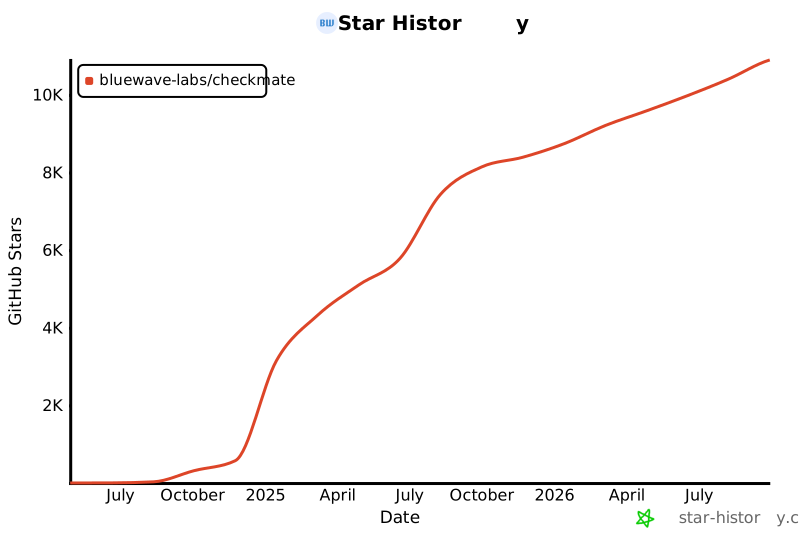](https://star-history.com/#bluewave-labs/bluewave-uptime&Date)
## Patrocinadores
Gracias a [Gitbook](https://gitbook.io/) por darnos una cuenta gratuita para su plataforma de documentación, y a [Poeditor](https://poeditor.com/) por proporcionarnos una cuenta gratuita para servicios de traducción. Si deseas patrocinar Checkmate, por favor envía un correo a hello@bluewavelabs.ca
Si deseas patrocinar una función, [visita esta página](https://checkmate.so/sponsored-features).
También puedes revisar otros proyectos de BlueWave orientados a desarrolladores y contribuidores:
- [VerifyWise](https://github.com/bluewave-labs/verifywise), la primera plataforma de gobernanza de IA de código abierto.
- [DataRoom](https://github.com/bluewave-labs/bluewave-dataroom), una aplicación de intercambio de archivos seguro, también conocida como dataroom.
- [Guidefox](https://github.com/bluewave-labs/guidefox), una app que ayuda a nuevos usuarios a aprender a usar tu producto mediante pistas, tours, popups y banners.
@@ -40,12 +61,14 @@ Checkmate has been stress-tested with 1000+ active monitors without any particul
- [🤝 Contributing](#contributing)
<a id="demo"></a>
## Demo
You can see the latest build of [Checkmate](https://demo.checkmate.so/) in action.
The username is demouser@demo.com and the password is Demouser1! (just a note that we update the demo server from time to time, so if it doesn't work for you, please ping us on the Discussions channel).
<a id="users-guide"></a>
## User's guide
Usage instructions can be found [here](https://checkmate.so/docs).
@@ -54,28 +77,182 @@ Usage instructions can be found [here](https://checkmate.so/docs).
- [Docker](https://www.docker.com/) installed
- [Git](https://git-scm.com/) installed
<a id="installation"></a>
## Installation
See installation instructions in [Checkmate documentation portal](https://checkmate.so/docs).
The quickest way to run Checkmate is the reference Docker Compose file. It starts two services: the all-in-one Checkmate application image (`ghcr.io/bluewave-labs/checkmate`) and a separate MongoDB service.
Alternatively, you can also use [Coolify](https://coolify.io/), [Elestio](https://elest.io/open-source/checkmate), [K8s](./charts/helm/checkmate/INSTALLATION.md), [Sive Host](https://sive.host) (South Africa), [Cloudzy](https://cloudzy.com/marketplace/checkmate) or [Pikapods](https://www.pikapods.com/) to quickly spin off a Checkmate instance. If you would like to monitor your server infrastructure, you'll need [Capture agent](https://github.com/bluewave-labs/capture). Capture repository also contains the installation instructions.
> **What “all-in-one” means:** the Checkmate application is packaged in a single image; MongoDB is not embedded in that image and remains required. The reference Compose file starts MongoDB for you. For custom deployments, configure `DB_CONNECTION_STRING` to use an external MongoDB instance.
JWT_SECRET="$(openssl rand -hex 32)" docker compose up -d
```
Then open http://localhost:52345. If the app is reached at another origin (domain or LAN IP), set `CLIENT_HOST` accordingly. To build the image yourself, run `docker build -f docker/Dockerfile -t checkmate .` from a checkout. For TLS, put any reverse proxy (Caddy, Traefik, nginx) in front of port 52345.
There are also 1-click installation options like [Repocloud](https://repocloud.io/details/Checkmate),
[Pikapods](https://www.pikapods.com/), [Coolify](https://coolify.io/), [Elestio](https://elest.io/open-source/checkmate), [K8s](./charts/helm/checkmate/INSTALLATION.md), [Sive Host](https://sive.host) or [Cloudzy](https://cloudzy.com/marketplace/checkmate). Note that the Helm chart has not yet been migrated to the all-in-one image: it still deploys the legacy `checkmate-client`, `checkmate-backend` and `checkmate-mongo` images, pinned at v3.8.1.
### Configuration
The image is configured entirely through environment variables on the server container:
| `JWT_SECRET` | Yes | Secret used to sign auth tokens; generate one with `openssl rand -hex 32` |
| `CLIENT_HOST` | Yes | The URL users reach the app at, e.g. `https://checkmate.example.com`; used for CORS and for links in notifications and emails |
| `ENCRYPTION_KEY` | No | Encrypts stored Docker TLS client keys at rest; generate one with `openssl rand -base64 32`. Comma-separated list: the first key encrypts, every key decrypts. Must be identical on the API and every worker. To rotate without downtime, deploy `OLD_KEY,NEW_KEY` everywhere, then `NEW_KEY,OLD_KEY` everywhere, wait for the worker to re-encrypt every row, then drop `OLD_KEY`. |
| `PORT` | No | Port the API and web client are served on (default `52345`) |
| `HEALTH_PORT` | No | Port for the `/livez`, `/readyz` and `/metrics` endpoints, served by any process that runs the job worker (default `52346`) |
| `NODE_ENV` | No | `development`, `production` or `test` (default `development`). `development` disables the general API rate limiter; set `production` on real deployments |
| `LOG_LEVEL` | No | Server log level: `error`, `warn`, `info`, or `debug` (default `debug`) |
| `TOKEN_TTL` | No | Lifetime of issued auth tokens, e.g. `12h` or `7d` (default `99d`) |
| `QUEUE_MODE` | No | `primary` (default) runs the API, the web client and the job scheduler; `worker` runs a job-processing worker only, with no API |
| `QUEUE_PRIMARY_PROCESSES` | No | `true` (default) or `false`. Whether a `primary` node also processes monitoring jobs itself; set `false` when dedicated `worker` nodes handle all checks. Ignored in `worker` mode |
| `STATUS_PAGE_THEMES_ENABLED` | No | `true` (default) or `false`. When `false`, status pages ignore theme settings and always render the default theme |
The web client needs no configuration by default: it calls the API on the same origin it was served from (`/api/v1`). For setups where the defaults don't apply — for example, the API is reached through a different origin than the page — the server renders overrides into the client at runtime via these optional variables:
| Variable | Description |
|---|---|
| `CLIENT_CONFIG_API_BASE_URL` | Full base URL the client calls the API at, e.g. `https://api.example.com/api/v1`; defaults to same-origin `/api/v1` |
| `CLIENT_CONFIG_CLIENT_HOST` | Origin used when the client builds absolute links (invites, status pages); defaults to the browser's current origin |
> **Upgrading from an older image?** The `UPTIME_APP_*` variables (`UPTIME_APP_API_BASE_URL`, `UPTIME_APP_CLIENT_HOST`, `UPTIME_APP_LOG_LEVEL`) are no longer read. In most setups no replacement is needed — the same-origin defaults cover them; if you pointed the client at a different origin, use the `CLIENT_CONFIG_*` equivalents above. The `checkmate-client`, `checkmate-backend`, `checkmate-mongo`, and `checkmate-backend-mono-multiarch` images are no longer updated — switch to `ghcr.io/bluewave-labs/checkmate`, keeping your existing MongoDB service and data volume.
See full installation instructions in the [Checkmate documentation portal](https://checkmate.so/docs).
Alternatively, you can also use [Coolify](https://coolify.io/), [Elestio](https://elest.io/open-source/checkmate), [K8s](./charts/helm/checkmate/INSTALLATION.md) (legacy images, pinned at v3.8.1), [Sive Host](https://sive.host) (South Africa), [Cloudzy](https://cloudzy.com/marketplace/checkmate) or [Pikapods](https://www.pikapods.com/) to quickly spin off a Checkmate instance. If you would like to monitor your server infrastructure, you'll need [Capture agent](https://github.com/bluewave-labs/capture). Capture repository also contains the installation instructions.
### Using a Custom CA
If you need to monitor internal HTTPS endpoints with certificates from private Certificate Authorities (like Smallstep), see our [Custom CA Trust Guide](./docs/custom-ca-trust.md) for Docker configuration options.
### Docker monitors
A Docker monitor connects to a Docker daemon and reports on every container it runs. The daemon's ping response decides whether the monitor is up or down and its latency is the response time. Each check also records every container's state, health, CPU and memory usage, restart count, published ports and mounts. Enabling **Collect container logs** additionally stores the latest 200 log lines per container on every check; logs are kept for 7 days.
The **Docker host** field accepts two forms:
| Host | Example | Notes |
|---|---|---|
| Local socket | `unix:///var/run/docker.sock` | Also accepts a bare absolute path such as `/var/run/docker.sock`. Use this for the daemon on the same machine Checkmate runs on. |
| Remote daemon | `tcp://docker.example.com:2376` | Always uses mutual TLS; the port defaults to `2376`. Unencrypted daemons on `2375` are not supported. |
**Monitoring the local socket.** The reference Compose file does not mount the socket, so add it and grant the container the host's `docker` group. The image runs as an unprivileged user and cannot read the socket otherwise. Find the group id with `stat -c %g /var/run/docker.sock`, then:
```yaml
services:
checkmate:
volumes:
- /var/run/docker.sock:/var/run/docker.sock:ro
group_add:
- "989"# the gid printed by stat
```
**Monitoring a remote daemon.** Set the host to `tcp://host:port` and fill in the **TLS credentials** section of the monitor form with the same PEM files you would pass to `docker --tlsverify`:
- **CA certificate**: the CA that signed the daemon's server certificate. Required unless **Ignore TLS/SSL errors** is on, which skips verifying the daemon's identity.
- **Client certificate**: the certificate the daemon uses to authenticate Checkmate.
- **Client key**: the matching private key, unencrypted (no passphrase). Checkmate checks that it matches the certificate, encrypts it with `ENCRYPTION_KEY`, and never shows it again. Leave the field blank when editing to keep the stored key.
TLS Docker monitors require `ENCRYPTION_KEY` to be set on the server (see [Configuration](#configuration)). Saving one without it fails with an error telling you so. If the key is ever removed or rotated incorrectly, affected checks fail with a decryption error until it is restored.
If the daemon's certificate is signed by a private CA that you also want the rest of Checkmate to trust, see the [Custom CA Trust Guide](./docs/custom-ca-trust.md); for Docker monitors alone, the **CA certificate** field is enough.
### Securing the Docker daemon with TLS
The Docker daemon does not enable TLS by default. Follow these steps on the Docker host to generate a CA, a server certificate, and a client certificate for Checkmate. This is the procedure from [Docker's own guide](https://docs.docker.com/engine/security/protect-access/), condensed. Replace `docker.example.com` and `203.0.113.10` with your daemon's DNS name and IP.
**1. Create a CA.** The CA key gets a passphrase; keep it offline once the certificates are issued.
**4. Point the daemon at the certificates.** Move `ca.pem`, `server-cert.pem` and `server-key.pem` to `/etc/docker/certs/` and configure `/etc/docker/daemon.json`:
On distributions where the systemd unit already passes `-H fd://` (Debian, Ubuntu and derivatives), the daemon refuses to start with `hosts` set in both places. Remove the flag from the unit with an override, then restart:
For more documentation, see the [docs directory](./docs/).
<a id="performance"></a>
## Performance
Thanks to extensive optimizations, Checkmate operates with an exceptionally small memory footprint, requiring minimal memory and CPU resources. Here’s the memory usage of a Node.js instance running on a server that monitors 323 servers every minute:
- Multi-language support for Arabic, Chinese (Simplified), Chinese (Traditional, Taiwan), Czech, English, Finnish, French, German, Japanese, Portuguese (Brazil), Russian, Spanish, Thai, Turkish, Ukrainian, and Vietnamese
- Multi-language support for Arabic, Catalan, Chinese (Simplified), Chinese (Traditional, Taiwan), Czech, English, Finnish, French, German, Italian, Japanese, Polish, Portuguese (Brazil), Russian, Spanish, Thai, Turkish, Ukrainian, and Vietnamese
## Monitor Lifecycle
@@ -109,6 +287,7 @@ Feel free to ask questions or share your ideas - we'd love to hear from you!
5. Upon a state change: an incident is either created or resolved, depending on the monitor's current status
6. Notifications are triggered based on configuration
<a id="screenshots"></a>
## Screenshots
<p>
@@ -126,6 +305,7 @@ Feel free to ask questions or share your ideas - we'd love to hear from you!
<a id="tech-stack"></a>
## Tech stack
- [ReactJs](https://react.dev/)
@@ -135,6 +315,7 @@ Feel free to ask questions or share your ideas - we'd love to hear from you!
- [Recharts](https://recharts.org)
- Lots of other open source components!
<a id="a-few-links"></a>
## A few links
- If you would like to support us, please consider giving it a ⭐ and click on "watch".
@@ -142,11 +323,12 @@ Feel free to ask questions or share your ideas - we'd love to hear from you!
- Need a ping when there's a new release? Use [Newreleases](https://newreleases.io/), a free service to track releases.
- Watch a Checkmate [installation and usage video](https://www.youtube.com/watch?v=GfFOc0xHIwY)
<a id="contributing"></a>
## Contributing
We are [Alex](http://github.com/ajhollid) (team lead), [Gorkem](http://github.com/gorkem-bwl/), [Aryaman](https://github.com/Br0wnHammer), [Mert](https://github.com/mertssmnoglu) and [Karen](https://github.com/karenvicent) helping individuals and businesses monitor their infra and servers.
We are [Alex](http://github.com/ajhollid) (team lead), [Gorkem](http://github.com/gorkem-bwl/), [Aryaman](https://github.com/Br0wnHammer), [Malena](https://github.com/malenacaroline) and [Mert](https://github.com/mertssmnoglu) helping individuals and businesses monitor their infra and servers.
We pride ourselves on building strong connections with contributors at every level. Despite being a young project, Checkmate has already earned 7000+ stars and attracted 90+ contributors from around the globe.
We pride ourselves on building strong connections with contributors at every level. Despite being a young project, Checkmate has already earned almost 11K stars and attracted 150+ contributors from around the globe.
Our repo is starred by employees from **Google, Microsoft, Intel, Cisco, Tencent, Electronic Arts, ByteDance, JP Morgan Chase, Deloitte, Accenture, Foxconn, Broadcom, China Telecom, Barclays, Capgemini, Wipro, Cloudflare, Dassault Systèmes and NEC**, so don’t hold back — jump in, contribute and learn with us!
If your KEDA/Mongo versions reject the `$$NOW`/`$toLong` query, or you already run Prometheus, scrape
the worker's `/metrics` (`checkmate_worker_due_backlog`), expose it via prometheus-adapter, and target
it with a standard `HorizontalPodAutoscaler`. The manifest is left to the operator; the app computes
`now` in code on this path, so the query coercion is unnecessary.
## Enabling TLS/HTTPS with cert-manager
If you have [cert-manager](https://cert-manager.io/) installed in your cluster, you can enable automatic TLS certificate provisioning using Let's Encrypt or other certificate issuers.
@@ -68,7 +198,7 @@ client:
enabled:true
secretName:checkmate-client-tls
server:
api:
protocol:https
ingress:
enabled:true
@@ -78,7 +208,7 @@ server:
cert-manager.io/cluster-issuer:"letsencrypt-prod"
tls:
enabled:true
secretName:checkmate-server-tls
secretName:checkmate-api-tls
```
### Alternative: Using --set flags
@@ -88,13 +218,13 @@ You can also enable TLS during installation using Helm's `--set` flags:
{{- if and .Values.client.ingress.tls.enabled (not $clientHasIssuer) }}
{{- fail "client.ingress.tls.enabled is true but no cert-manager issuer annotation found. Add 'cert-manager.io/cluster-issuer' or 'cert-manager.io/issuer'." }}
{{- end }}
{{- if and .Values.server.ingress.tls.enabled (not $serverHasIssuer) }}
{{- fail "server.ingress.tls.enabled is true but no cert-manager issuer annotation found. Add 'cert-manager.io/cluster-issuer' or 'cert-manager.io/issuer'." }}
{{- if and $api.ingress.tls.enabled (not $apiHasIssuer) }}
{{- fail "api.ingress.tls.enabled is true but no cert-manager issuer annotation found. Add 'cert-manager.io/cluster-issuer' or 'cert-manager.io/issuer'." }}
{{- end }}
{{/* Secret name can be omitted; we default to <release>-client|server-tls in templates */}}
{{/* Worker grace period must exceed the server drain timeout (25s) or workers are SIGKILLed mid-drain */}}
{{- if and .Values.worker.enabled (le (int .Values.worker.terminationGracePeriodSeconds) 25) }}
{{- fail "worker.terminationGracePeriodSeconds must be greater than 25 (the server drain timeout) or workers are killed mid-drain" }}
{{- end }}
{{/* Secret name can be omitted; we default to <release>-client|api-tls in templates */}}
Loaded 100 of 779 files, more files were not shown because too many files have changed in this diff.
Show more
Reference in new issue
Block a user
Blocking a user prevents them from interacting with repositories, such as opening or commenting on pull requests or issues. Learn more about blocking a user.
 Alexander Holliday
 Jan Kahmen
 gorkem-bwl

 egeoztassandClaude Fable 5.1
 Malena AguiarandClaude Sonnet 4.6
 Ali Shan Ahmad
 Gorkem Cetin
 eegrok
 signalgridco
 eralpozcan
 Marcos Paulo Diniz
 colinjtsen2010
 Glazzze
 Anju
 Iven Schlenther
 Osamaali313
 Jakub Pomykała
 edobusy
 Harshitbro-ctrlv
 sanmaxdev
 Arnaud GRIMBERT
 Buco7854
 harsh-aghara
 Ian Troisi
 Rabson
 Br0wnHammer
 joaquimpeixoto
 Agustí Dosaiguas
 Iriome
 ZeinebMegaadi
 mannilakash