The conventions doc grew up as an FE-only thing. After the DNS provider
PR series highlighted real backend patterns that get repeatedly missed
in code review (DI, AppError envelope, schema enum, test setup style,
centralized Zod enums, OpenAPI response schemas), it makes sense to
have a single doc that covers both halves of the codebase.
Changes:
- Rename docs/frontend-conventions.md → docs/coding-conventions.md.
- Add a new top-level rule 0: look at peer implementations and follow
the established pattern. Applies to both FE and BE. Includes a
4-step "how to apply" and a self-check for PR authors.
- Keep the 5 frontend rules unchanged (rules 1-5).
- Add 6 backend rules (rules 6-11):
- Controller → Service → Repository → Mongoose layering.
- Provider skeleton (DI, SERVICE_NAME / TIMEOUT_MS, timeRequest,
inline setTimeout race, outer AppError catch).
- Mongoose enum reusing types/* const tuples.
- Provider test conventions (file location, @jest/globals, contract
test, inline setup() per test).
- Centralize Zod enums in types/* — don't duplicate.
- New entity fields must land in *ResponseSchema for OpenAPI.
- Pre-PR checklist split into Universal / Frontend / Backend.
- CLAUDE.md updated to reference the new file and summarize all 11
rules + rule 0.
Use find + updateMany with timestamps:false instead of find IDs +
updateMany + fetch updated. Manually set updatedAt and edit
in-memory documents to avoid a third DB round trip.
Fixes#3602
Addresses PR feedback:
- Upgrades bulk pausing from Promise.all to Promise.allSettled
- Logs individual job queue sync failures with monitor ID context
- Surfaces failedCount to the frontend via controller response
- Adds unit tests to verify partial failure handling
Fixes#3602
Addresses PR feedback:
- Replaces forbidden any type in catch block with unknown
- Adds type discrimination using axios.isAxiosError and instanceof Error
- Narrows error type for logger.error compatibility
Fixes#3602
Adds explicit 'align' support to Table headers to override strict index-based alignment. Restores exact center-alignment spacer boxes to Uptime and Infrastructure tables to match develop branch styling.
Fixes#3602
Resolves maintainer feedback regarding UI/UX layout and prevents code collisions with other PRs by extracting action logic out of the bar component.
Fixes#3602
Anonymous visitors to a public status page have no persisted Redux
state, so ThemedHeatmap and ThemedHistogram tooltips always rendered
timestamps in the hardcoded "America/Toronto" default — regardless of
the timezone the operator configured. Even on the same domain,
ThemedHeatmap and ThemedHistogram had no code path to consume the
operator-configured statusPage.timezone returned by the API.
- Add SYSTEM_TIMEZONE module constant and a small resolveTimezone()
helper to TimeUtils.ts. formatDateWithTz's timezone parameter is now
optional and defaults to the system tz, so callers don't need to
rebuild the prop -> browser -> UTC chain inline.
- Add a `timezone` field to StatusPageThemeContextValue so any themed
component on the public page can read the page-wide tz without prop
drilling (parallels how `theme` and `mode` are already exposed).
- Wire statusPage.timezone into StatusPageThemeProvider from
Pages/StatusPage/Status/index.tsx (both the public route and the
admin preview).
- ThemedHeatmap and ThemedHistogram now read tz from the context
instead of useSelector(state.ui.timezone) — that selector was
unreliable for anonymous visitors and removing it cuts a Redux
subscription on the public page.
- Replace the inline `data?.timezone || Intl.DateTimeFormat()...`
expression in useStatusPageForm.ts with resolveTimezone().
Closes#3628.
Translates captureUrl.label ("Capture endpoint") and the new long
description.hardware copy into all 15 non-English locales (ar, cs, de,
es, fi, fr, ja, pt-BR, ru, th, tr, uk, vi, zh-CN, zh-TW). The literal
URL example and the token name "Bearer" are kept untranslated.
The previous commit overwrote description.hardware with English in 15
non-English locales. Restore each locale's existing translation; only
the en.json copy carries the new path/Bearer guidance. Translators will
pick up the English text on the next PoEditor sync.
The previous commit added inline helperText under the URL and Secret
fields, but no other form in the codebase uses helperText for static
guidance — only for validation errors. The project's pattern for setup
guidance is the ConfigBox subtitle text on the left side of the form,
populated from pages.createMonitor.form.general.description.<type>.
Move the guidance there so this form follows the same convention as
every other monitor type.
- Remove urlHelperText / secretHelperText from GeneralSettingsConfig
- Remove the new helperText props on the URL and Secret TextFields
- Drop captureUrl.helperText and secret.helperText keys from all
16 locales
- Beef up description.hardware to mention the /api/v1/metrics path
requirement and the no-Bearer-prefix rule
The realistic captureUrl placeholder (added in the previous commit)
stays — it does most of the URL-disambiguation work on its own.
Two real users hit the same confusion: the Capture endpoint URL needs
the full path /api/v1/metrics, and the authorization secret should not
include a "Bearer" prefix. The form previously gave no guidance on
either — same generic placeholder as HTTP monitors and no helper text.
- Replace the URL field's generic label/placeholder with hardware-
specific copy ("Capture endpoint", realistic 192.168.1.10:5001/...
example) and add helper text under the field.
- Add helper text under the authorization secret field clarifying that
only the raw token belongs there — Bearer is added automatically.
- Wire optional urlHelperText / secretHelperText through
GeneralSettingsConfig so other monitor types are unaffected.
- Add three new i18n keys (captureUrl.label/placeholder/helperText)
and one (secret.helperText) to all 16 locales. Non-English locales
carry the English copy as a placeholder until translators pick the
keys up via the existing PoEditor pipeline.
Adapted from #3579 by @gorkem-bwl. The openapi/registry, helpers, and
per-resource routes/* files are largely their work; this commit relocates
the directory out of src/ so the build-time generator code is not emitted
into dist/, and shifts spec generation from runtime to a build step.
Co-authored-by: gorkem-bwl <gorkem.cetin@bluewavelabs.ca>
- Mounts selection checkboxes in UptimeMonitorsTable and MonitorsTable
- Enhances global Table.tsx to cleanly render checkboxes on mobile cards via mobileLabel
- Injects BulkActionsBar into main list views
Fixes#3602
- Extracts generic table selection logic into useTableSelection hook
- Creates BulkActionsBar component with Collapse animations
- Implements useBulkMonitorActions to handle API logic and toasts
- Adds i18n translation strings across all 16 locales
Fixes#3602
Patches CVE-2026-41650 (medium — XML comment and CDATA injection via unescaped delimiters in XMLBuilder).
Transitive bump within existing semver range; no package.json change.
Patches CVE-2026-33671 (high — ReDoS via extglob quantifiers) and CVE-2026-33672 (medium — method injection via POSIX character classes).
Transitive bump within existing semver range; no package.json change.
## Changes
- Pin multer from ^1.4.5-lts.1 to ^1.4.5-lts.2
## Benefits
- Picks up the latest 1.x LTS patch (released 2025-03-20)
- Patch-level bump within existing semver range; no API changes
- Two routes use multer (authRoute, statusPageRoute) and both rely only on the stable basic API
## Changes
- Bump axios from ^1.7.x to ^1.15.2 in both client/ and server/
## Benefits
- Patches CVE-2025-62718 (NO_PROXY hostname normalization SSRF)
- Patches CVE-2026-40175 (cloud metadata exfiltration via header injection)
- Minor bump within existing ^1.x semver range; no API changes
The transport JSON preview is strictly for verifying what is handed to
nodemailer.createTransport. The From header is built per-message in
sendMail, so showing it inside the transport JSON was misleading. The
separate From: ... pre block below the JSON is the right place for
that preview.
The /settings transport preview shows `from` inside the createTransport
JSON, but the implementation was passing it per-message via sendMail.
Switch to passing it as part of the transport config so what the
preview shows matches what is actually built — no behavioural change
for outgoing emails since nodemailer treats transport-level `from` as
the default for every sendMail call.
Brings back the second pre-block I dropped when consolidating the
preview. The transport JSON shows what's handed to nodemailer
createTransport; the From-header block shows the rendered envelope
recipients will see — they answer different questions and both belong.
Conditioned on systemEmailAddress so empty configs don't render an
empty pre.
Closes#3600. Previously the From header on test emails and notifications
showed only the raw email address. Adds an optional "Sender name" field
so emails appear from a friendly name like "Checkmate notifications"
<user@example.org>.
## Behaviour
- Field is optional. When empty/null/whitespace, the From header falls
back to the raw email address — identical to current behaviour, no
regression for existing installs.
- When set, the email service hands nodemailer { name, address } as the
message from field. Nodemailer handles RFC-5322 encoding (quotes,
commas, non-ASCII) so the display name is safe for any input.
- Unsetting works: clearing the input transforms the value to null in
the Zod parse step, and the settings repository already turns null
values into a $unset operation.
- Both client and server Zod schemas trim and empty-string-to-null,
preventing whitespace-only display names from being stored.
## Surfaces
- AppSettings schema, Settings type, EmailTransportConfig pick, server
Zod validation, client Zod validation, client form defaults, and the
Settings page form all carry the new systemEmailDisplayName field.
- The transport preview pre-block on /settings now includes a `from`
key showing exactly what the email service hands nodemailer — the
string when no display name is set, or { name, address } when it is.
- en.json carries the new label and placeholder. Other locales fall
back until translated (16 locales pending — separate follow-up).
## Conventions conformance (per docs/frontend-conventions.md)
- The pre-block I touched had three rule #1 violations (sx p,
borderRadius, backgroundColor); hoisted those to native props using
theme.shape.borderRadius. Other rule #1 violations elsewhere on this
page are pre-existing and intentionally left alone.
- No new sx-with-native-equivalents introduced.
- No color="text.X" shorthand introduced.
- No theme module import introduced.
Capture the five recurring code-review patterns from the recent PR series
(#3591–#3596) as enforceable rules so they don't have to be raised again
in review.
## Conventions
- Prefer MUI native props over `sx` (e.g. color={...}, mt={...}, width={...}).
- Use the full theme path for colors: theme.palette.text.secondary, never
the "text.secondary" shorthand string. The shorthand is invisible to
grep, which makes future audits and refactors miss callsites.
- No hardcoded numeric or string literals — use LAYOUT, typographyLevels,
theme.shape.borderRadius, theme.palette tokens.
- Use useTheme() inside components; don't import { theme } from
@/Utils/Theme/Theme (factory output, not a live mode-aware instance).
- Pair runtime tuples with derived types so they can't drift.
## Files
- docs/frontend-conventions.md — long-form doc with before/after examples
drawn from the actual review fixes, plus a pre-PR checklist.
- CLAUDE.md — short summary in the Code Conventions section pointing to
the doc, so it's loaded into agent context at session start.
## ESLint enforcement
- client/.eslintrc.cjs — four no-restricted-syntax selectors for each rule:
- color="…" / bgcolor="…" / borderColor="…" with a dotted shorthand value
- sx={{ key: ... }} where key has a native equivalent, only on hoistable
components (Box, Stack, Typography, Grid, Container, Paper, Card*,
Divider, Link, Chip) — Dialog/Drawer/Menu etc. only accept sx.
- import { theme } from "@/Utils/Theme/Theme"
- Typography fontSize={13} (the body default — drop the prop).
- TypeScript files are now actually parsed: added @typescript-eslint/parser
and @typescript-eslint/eslint-plugin and a TS override that extends the
React plugin configs. Several @typescript-eslint/recommended rules
disabled to avoid noise on the existing codebase.
- client/package.json — lint script now covers .ts/.tsx; new lint-strict
script for CI use once the codebase is conformant; --max-warnings 0
removed from `lint` so existing-code warnings don't block the workflow.
## Surface
Running `npm run lint` after this change reports ~280 warnings against
the existing codebase, almost all from rule #1 (sx-vs-native). These are
intentionally warnings, not errors — they surface the work without
blocking. Each warning links to the rule number in the conventions doc
so the reasoning is one click away.
The remove-all-monitors confirmation dialog only had a one-line title
and an empty body, which looked awkward and didn't communicate what was
actually about to be deleted alongside the monitors themselves.
- Adds a paragraph explaining that check history, incidents, scheduled
maintenance windows, and dependent status pages will also be removed,
with an inline tip to export monitors first to keep a backup.
- The Confirm button now uses confirmColor='error' to make the
destructive action visually distinct, with a localized
'Remove monitors' label.
- Translated to all 16 locales, with terminology aligned to each
locale's existing usage (e.g. zh-CN/zh-TW use 监控/監控 to match the
existing button label, vi uses 'trình giám sát', etc.).
When Capture runs inside a container (typical for Docker Desktop), the
only visible interfaces are loopback, so every bytes_sent/bytes_recv
counter is zero and the charts render as flat lines without any
explanation. Users couldn't tell whether Capture was unreachable, the
monitor was broken, or there was just genuinely no traffic.
Detect the case where checks exist (chart configs were built) but every
interface across every check reports zero bytesSentPerSecond and
deltaBytesRecv, and render a NoticeBanner above the chart grid
explaining it and suggesting Capture be run on the host.
Adds pages.infrastructure.charts.labels.netNoTraffic to all 16 locales.
- All uppercase headers (Active Incidents, Latest Incidents, Incident
Statistics, Resolved Incidents, summary card titles, details card
sections) now use the existing 'eyebrow' typography variant. That's
the same style used on the Logs page and lives in Theme.ts so future
tweaks land in one place.
- Latest Incidents and Incident Statistics rows now share a minHeight
so both cards line up vertically; Latest Incidents items dropped
their extra dividers and Box wrappers.
- Body text in the summary cards (and the details dialog) uses
variant=body1 (13px) consistently — previously a mix of body1/body2
and unspecified Typography.
- All lucide icons in CardSummary go through the design-system <Icon>
wrapper so they share the project's strokeWidth=1.5 default rather
than lucide's default 2.
- ControlsIncidentFilter: replaced the missing
pages.incidents.filters.clearFilters key (which was rendering as
raw text) with the existing common.buttons.clearFilters.
- CardDetails: extracted local SectionHeading and Cell helpers; switched
the cards' bare <Typography> cells to variant=body1 + variant=eyebrow
for headings; dropped redundant title-dividers (eyebrow style already
separates visually).
- AddTeamMemberDialog: First name / Last name now share a row, and
Password / Confirm password share a row. Each field uses sx={flex:1}
so the row totals match the width of the email/role rows below.
- InviteTeamMemberDialog: drop the redundant mt={theme.spacing(...)}
workaround on the form Stack (the new Dialog component provides this
spacing).
- Constants conformance: spacing literals replaced with LAYOUT.XS.
- Button.tsx: contained variant's hover now uses HOVER.DARKEN=0.06
instead of MUI's default 16%, which was visibly heavy on the green
primary buttons across the app. Also fixes a subtle bug where the
earlier hover sx merge order silently dropped the boxShadow:'none'
reset. Added a HOVER token group to constants.ts so the darken value
has a single source of truth.
- TextInput.tsx: forward the caller's sx to the wrapper Stack when a
fieldLabel is present (previously it was applied to the inner
TextField, so flex:1 etc. didn't propagate to the visible width).
Inner sx now also explicitly width:100% so wrapped inputs don't
collapse to content width when their parent is a flex row.
- FieldLabel.tsx: drop the hardcoded fontSize:'14px' and use
variant=body1 (=13px from theme) to match the rest of the app's
body typography.
Dialog component:
- Title bar gets a subtle background tint + bottom border. Title is
variant=h2 weight=600. Description tucks under the title with
variant=body1 secondary color (replaces MUI's DialogContentText).
- Action bar gets a matching subtle tint + top border. Cancel is now
outlined (was contained-error, which made every modal's Cancel button
look destructive). Confirm keeps its color (primary by default,
caller can pass error for destructive flows).
- Content area sits between with its own breathing room baked in, so
callers no longer need mt={theme.spacing(...)} workarounds.
- The cancelColor prop is removed; sites that genuinely need a
destructive Cancel can use confirmColor='error' on the Confirm button
instead.
NoticeBanner design-element:
- Extracted from the inline alert pattern in PageSpeedKeyPriorityFallback
into a reusable component with severity=info|warning|error.
- Refactored PageSpeedKeyPriorityFallback to use it.
DialogResolution.tsx: drop the now-removed cancelColor prop and the
mt-Box wrapper that's no longer needed (Dialog provides the spacing).
Fills in machine translations for ar, cs, fi, fr, ja, pt-BR, tr, uk, vi
so every locale now ships a native translation of the game-monitor
description (including the new server-query setup sentence and the
<gamedigLink> placeholder).
The game monitor type relies on each game's native query protocol — many
require a config file change on the game server (e.g. Minecraft Java
needs `enable-query=true` in `server.properties`). Without that, the
monitor silently fails to reach the server.
Append a sentence to the game-type general settings description that:
- tells the user some games need server-side queries enabled
- points them to the GameDig supported-games list for protocol details
Implementation:
- Use <Trans> with a `gamedigLink` slot so the link renders inline
- Loosen ConfigBox `subtitle` from `string` to `React.ReactNode` so the
subtitle can host the <Trans> output
- Update all 16 locale files. Six (de, es, ru, th, zh-CN, zh-TW) get a
full translation of the new sentence; nine empty ones (ar, cs, fi, fr,
ja, pt-BR, tr, uk, vi) fall back to the English string per the locale
gap policy
Four small follow-ups from a code review pass:
1. Drop the redundant `?? THEMED_RENDERERS[DEFAULT_STATUS_PAGE_THEME]`
fallback in Status/index.tsx — the map is now a total Record, so the
first lookup cannot return undefined.
2. Extract the literal "/status/public" into PUBLIC_STATUS_PAGE_PREFIX in
Types/StatusPage.ts and reuse from the three runtime call sites
(Status/index.tsx, HeaderStatusPageControls.tsx, StatusPagesTable.tsx).
The Routes/index.tsx route definition keeps its string literal — the
route table is otherwise all literals and the prefix only matters when
it's interpolated.
3. Delete two narrating comments above the public/admin branches in
Status/index.tsx — the JSX is self-describing.
4. Move the inline `style` object construction in StatusPageThemeProvider
into the existing useMemo so the wrapper div receives a stable style
reference. The previous spread defeated the surrounding memoization on
every render.
The 4 themed renderers (refined, modern, bold, editorial) cover every
StatusPageTheme value and the model defaults to "refined", so the legacy
fallback path in Status/index.tsx was unreachable in practice.
Removing it lets us delete:
- theme-overrides.css (the only remaining CSS file in StatusPage)
- StatusBar / MonitorsList / InfrastructureMetrics (only the legacy
fallback consumed them)
- The .sp-* className hooks that wired CSS rules into the components
Pure sx via the per-theme styles.ts recipes is now the single source of
truth for every status page surface. Net diff is -801 / +42.
Status/index.tsx now resolves a renderer from the theme map (falling back
to the default theme) and keeps the public-route and admin-preview
branches it already had.
CONTRIBUTING.md: surface format-check + build in code guidelines
and the PR checklist so contributors run the same verifications
the project enforces locally.
CLAUDE.md: correct stale test framework reference (Mocha+Chai+Sinon
-> Jest) and update the test file glob to server/test/**/*.test.ts.
Apply review feedback:
- Extract makeStatusPage from the two test files that duplicated it (test/unit/services/statusPageService.test.ts and test/unit/controllers/statusPageThemeFlag.test.ts) into test/helpers/makeStatusPage.ts. Both files now import the shared helper, matching the existing test/helpers/ convention used for repository fakes and provider contracts
- Add a blank line in statusPageController.getStatusPageByUrl between the normalizedMonitors map and the themesEnabled lookup so the response-shaping section breathes a bit
- Drop the obsolete localStorage references from the plan doc that survived from an earlier draft of the design — the public page never persisted a per-visitor mode choice in localStorage, so the test bullet under 2.11 and the risk row both pointed at functionality that does not exist
Address review follow-ups on PR #3568:
- Extract the controller's withoutThemeFields and applyDefaultTheme helpers from a private class field into a standalone module (controllers/statusPageThemeFlag.ts) so they can be tested without a controller harness; the controller is now a one-line consumer
- Add 9 unit tests covering both helpers (test/unit/controllers/statusPageThemeFlag.test.ts): no-mutation guarantees, partial inputs, all-fields-preserved verbatim, override-with-defaults semantics, and "page has no theme set yet" — the flag-off path is now exercised in both directions
- Expand the comment over withoutThemeFields to spell out why the strip is silent rather than a 400: this is an ops kill switch, not API semantics; clients shouldn't need to know whether themes are disabled today
Two caveats called out in review that this commit does NOT change:
- Mongoose `default:` directives only inject during hydration, not on partial updates. Legacy documents updated with `findOneAndUpdate` still won't have `theme` / `themeMode` written to Mongo. They render as defaults on read because the schema injects them — functionally equivalent, but the DB will hold a mix of present and absent fields indefinitely. Acceptable per the original commit intent.
- docs/plans/status-page-themes.md (304 lines) covers both backend and frontend work for the themes feature. It lives in this PR as the design artefact that drove both branches; moving it for purity would break the "where did this come from?" trail. Leaving it in.
- StatusPage Mongoose model: import DEFAULT_STATUS_PAGE_THEME / DEFAULT_STATUS_PAGE_THEME_MODE from types/statusPage so the four sources of the default literal stay locked together
- openapi.json: add explicit "default" alongside the enum on StatusPageTheme and StatusPageThemeMode component schemas; documentation already mentioned the defaults but the JSON didn't carry them
- statusPageController: add JSDoc-style comments above withoutThemeFields and applyDefaultTheme spelling out the asymmetric strip-on-write / force-on-read semantics so the next reviewer doesn't have to re-derive the design
Second /simplify pass picked up:
- pillHardware in refined and modern hardcoded blue hex codes (#60a5fa, #1d4ed8, #2563eb) while bold and editorial already used the green token system. Switch refined and modern to tokens.up / tokens.upSoft so all four themes are consistent and the public status page no longer leaks blue
- pill and pillHardware in refined and modern duplicated the shared 6 typography fields (fontSize, textTransform, letterSpacing, padding, borderRadius, fontWeight). Extract a pillBase constant per theme and spread, leaving only the colour deltas on each
- The 4 themes each defined their own font-stack constants. Consolidate them in themes/shared/fontStacks.ts (SANS_STACK, BOLD_SANS_STACK, SERIF_STACK, EDITORIAL_SECONDARY_SANS_STACK, MONO_STACK) and import. Drops 6 duplicated literal stacks
- modern dark-mode card hover used the light-mode shadow as a fallback. Add darkShadowHover and pick it up via cardHoverShadow when isDark
- refined and editorial styles factories silence their unused isDark parameter with `void isDark` instead of an underscore prefix; bold and modern still use it actively
Apply review feedback:
- Editorial chartSwitch: drop the per-button isFirst flag and put the divider on the parent via "& > button + button { borderLeft }"; chartSwitchButton(active) now matches bold/modern's signature
- Drop the empty company: {} entries in bold/modern and the wrapper span around the company name; the parent brand row already styles it
- Editorial styles factory: keep the (tokens, isDark) signature for cross-theme uniformity but acknowledge the unused isDark with a void-statement instead of an underscore prefix
Finishes the migration started for refined. Each theme now consumes the same pattern:
- A typed *Styles interface that names every entry the page consumes (no `as Function` casts at the call site)
- A *Styles factory that takes (tokens, isDark) and returns sx recipes derived from existing tokens.ts plus the shared toneColor/toneSoft helpers in shared/overallStatus
- A useMemo around the factory call so MUI's sx processor sees referential equality across renders that don't change tokens
- modern.css's keyframes (pulse + staggered fade-in + reduced-motion guard) ported via @mui/system keyframes inside the modern styles factory
- bold.css's hero glow + conic logo + pseudo-elements ported as inline sx via "&::before" / "& > *" selectors
- editorial.css's serif typography + hairline dividers + flat rectangular badges ported as plain sx with the serif/sans family stacks named at module scope
Drop the four .css files (~1789 lines) along with the className= attributes and the import "./*.css" lines in each StatusPage component.
The shared themed components (ThemedHeatmap, ThemedHistogram, ThemedInfrastructure) lose their legacy classPrefix branch entirely now that no theme uses it. The dual-API gate is gone; there is one path.
Verified: tsc --noEmit clean, prettier clean.
Note: theme-overrides.css remains for the legacy non-themed status page components (StatusBar, MonitorsList, HeaderStatusPageControls). That's separate scope from the four-theme work the reviewer flagged; can be migrated in a follow-up.
Apply review feedback:
- Type the styles factory's return as a named RefinedStyles interface so the consumer no longer needs `as Function` / `as any` casts on factory entries
- Lift toneColor / toneSoft to shared/overallStatus alongside the existing OverallTone type — the next three themes will need the same mapping
- Reuse heatLevel() in the legacy classPrefix branch of ThemedInfrastructure so both API paths share one threshold table
- Memoize the styles map in RefinedStatusPage so MUI's sx processor sees referential equality across renders that don't actually change tokens
- Make the dual-API gate in ThemedHeatmap / ThemedHistogram require ALL relevant sx props together so a partial migration can't silently fall back to the legacy class path
The reviewer's feedback on this PR is that the themes ship hardcoded class names against per-theme CSS files instead of following the project's MUI sx + theme.spacing()/palette pattern. This commit handles the refined theme as a proof of concept; the other three follow.
What changed
- New src/Pages/StatusPage/Status/themes/refined/styles.ts: a single function (tokens, isDark) -> sx recipes that mirror every rule in the deleted refined.css. All values are derived from the tokens already declared in tokens.ts so the colour/spacing source of truth doesn't change.
- RefinedStatusPage.tsx: drops the className= attributes and the import "./refined.css" in favour of sx={styles.x} drawn from the recipe map. Hardcoded class strings gone.
- refined.css: deleted (was 420 lines).
- Shared themed components (ThemedHeatmap, ThemedHistogram, ThemedInfrastructure): grew an opt-in sx-based API alongside the existing classPrefix one. The new API is what refined uses; bold / modern / editorial keep working unchanged on the legacy classPrefix path until they are migrated, after which the legacy code path is removed.
Verified
- tsc --noEmit clean
- prettier clean
- Pre-existing vite build error on this branch (flag-icons resolve, unrelated) is untouched
Next
- Convert the bold, modern and editorial themes the same way and remove the legacy classPrefix branch from the shared components.
- Seed the 29 keys that were missing in every non-English locale (Pushover/Twilio config, register setup notice, public status-page status-bar messages, "service is down")
- Fill core UI strings (sidebar menu, buttons, table headers, password rules, image upload, auth footer) where they were left as empty values in the original translations
- Bring Spanish to 100% net coverage with a hand pass over remaining empties and same-as-English entries
Coverage net of empty/missing keys:
- 6 locales now at 100% (de, es, ru, th, zh-CN, zh-TW)
- All locales above 94% (worst: ar/fi at 94.8%, was 85.1% / 87.9%)
- Zero missing keys in any locale (was 29 each)
Some keys are intentionally same-as-English (HTTP, gRPC, Pagespeed, Docker etc.). Long-form copy in createMonitor descriptions and a few infrastructure stat labels remain empty in the lower-coverage locales for native review.
- BaseAuthPage now renders a left form column and a right brand panel with eyebrow / tagline / description copy and a chess-board pattern over the brand green gradient
- Move the language selector and theme toggle to the page's top-right inside the form column so they read clearly in light and dark
- Every auth page (login, register, recovery, set new password) inherits the new layout
- Add brandPanel translations across all 16 locales; phrase the tagline as "your servers" instead of "stack" so it translates cleanly
- Default status-page colour now uses the brand green instead of a royal-blue hex
- PageSpeed API-key alert pulls from theme.palette.warning + alpha for both modes instead of hand-rolled amber values
- Settings JSON preview block uses action.hover instead of the hand-rolled #1e1e1e/#f5f5f5 pair
- Drop the redundant #E0E0E0 thumb override on SwitchComponent so the theme MuiSwitch override actually wins
- StatBox titles now use the eyebrow variant (matches /uptime summary cards)
- BaseChart drops its leading icon block and renders the title via eyebrow so all chart cards share one header style
- Inside the average-response gauge, the qualitative label uses eyebrow with the status colour and the metric uses h1; the gauge track is a neutral disabled-action background so the active arc reads in light and dark
Server-side, return 200 with success: false and a friendly message when sendTestNotification reports failure (the underlying call already swallows the error); reserve real 500s for unexpected exceptions.
Client-side, teach usePost to honour the response body's success flag so success:false flips the toast to error without throwing through axios. Also tidy the toast container: drop icons, no wrapping, single-line ellipsis with a sensible max-width that hugs short messages.
The destination column wrapped onto two lines for long webhook URLs. Cap the cell at 320px and use rtl + plaintext bidi so the start and end of the URL stay visible with an ellipsis in between; full address is in the title attribute.
The 6% primary tint that read fine in light mode disappeared against dark backgrounds. Use a 22% tint in dark mode (30% on hover) and keep the lighter 6/10% in light mode.
- Apply the eyebrow variant to "Runtime stats" and "Memory & CPU" so /logs sections share the same uppercase header style as Job queue
- Pair each section's heading + explainer with its table in a tighter sub-stack so the big gap only sits between sections, not under the explainer
- Restore the missing useTheme() call inside TableFailedJobs and TableLogs so the monospace token resolves
The sidebar selected-icon colour was sharing primary.main, which read too dark in dark mode. Introduce palette.sidebar.accent (brand green in light mode, a lighter green in dark mode) and route NavItem through it so primary stays brand-green for buttons and the rest of the UI.
- Drop the per-type icon
- Lower min-height to 40px and tighten padding
- Thin both the active progress bar and its track to 2px and pin them to the same baseline so they sit on top of each other
The autofill inset shadow was bleeding past the rounded corners. Clip it via overflow: hidden on the outlined input root and bump the override rules to !important so they beat Chrome's user-agent styles.
Drop the default MUI info-blue alert in favour of a neutral panel: theme-driven action.hover background, divider border, secondary text colour and no icon. Reads as a quiet aside instead of a status message.
Replace the flag + 2-letter code in the language selector with each language's native name (English, Deutsch, 日本語, ...) and drop the unused flag-icons dependency.
The login/register form used percentage widths that collapsed to ~15% on wide screens, wrapping the "Forgot password" / "Reset password" links onto two lines. Switch to a fixed 400px max-width that just shrinks below it on small screens.
Annotate the hex literals used when callers omit theme colours so the intent (defensive MUI default match) is obvious instead of looking like arbitrary values.
Add a fontFamilyMonospace token to theme.typography (ui-monospace stack with sensible fallbacks) and route the four ad-hoc fontFamily="monospace" call sites through it so the project has one source of truth.
- Tooltip backgrounds now pull from the theme's grey palette instead of a hand-rolled blue gradient (visible bug in dark mode)
- Toast progress bars use theme.palette.primary.main so they match the rest of the brand
- Introduce a reusable eyebrow Typography variant in the theme (13px, 500 weight, uppercase, 0.08em tracking) for section headings
- Apply it to ConfigBox titles in /settings and to "Job queue" / "Failed jobs" in /logs
- Drop the page header weight from 600 to 400 with tighter tracking so titles read lighter and more refined
Renames the primary palette token from blueBlueWave to brandGreen and points it at #13715B in both light and dark themes, so primary buttons, sidebar selection, slider rings, switch tracks etc. follow the brand instead of the old blue.
- Replace the blue chess-piece SVG with a green king silhouette adapted from Cburnett's chess set (Wikimedia Commons, CC BY-SA 3.0); applies to the page-header logo and the browser favicon
- Drop the placeholder green "C" square in the sidebar in favour of the same king SVG
- Add a NOTICE file documenting the asset attribution and license
Up/down/paused/initializing labels now use the same uppercase 11px treatment as the table headers, with looser tracking, instead of the heavier h2 variant.
Selected segment uses a 6% primary alpha rather than the previous green tint, and the per-button border override is gone so adjacent segments share one clean divider line.
- Switch: 36x20 contained pill with 6px right padding so labels keep their distance even inside Stacks
- Radio: theme-level override, 20px ring with a fixed-size inner dot — checked state no longer animates a scale change that pushed labels around
- Slider: white thumb with primary-colour ring, 4px track, soft hover/active glow
- Drop the custom RadioInput icon overrides that bypassed the theme and caused the size jiggle
- Replace duplicated page/rowsPerPage state in Team, Notifications and Status Pages tables with a shared useClientPagination hook
- Drop unused placeholderColor prop from Select; placeholder always uses secondary text
- Restore LAYOUT.MD constant for the account menu item gap
- replace heavier per-cell header borders with one lighter row divider
- shrink header text to 11px with looser tracking for a more refined feel
- tighten failed-jobs labels: "Fail count" -> "Count", "Last failed at" -> "Last failed"
Across en + 15 locales:
- pages.<X>.fallback.title / .description for every page that has an
EmptyState (uptime, infrastructure, pageSpeed, notifications,
maintenance, statusPages, incidents, logs, logs.queueFallback,
checks, account.team).
- pages.<X>.header.title / .description for every page that uses the
new PageHeader (same list, plus settings).
- pages.logs.diagnostics.sections.runtimeStats / .memoryCpu titles
and descriptions for the diagnostics section explainers.
- components.pageHeader.links.support / docs / changelog tooltip
labels.
en.json also gains pages.logs.jobQueueExplainer and
.failedJobsExplainer (English only — non-English locales fall back
to English until a translator sweep).
- MuiOutlinedInput hover override: was inheriting MUI's default
white outline in dark mode (too bright). Now uses an alpha-23%
white in dark and text.primary in light.
- TextInput: -webkit-autofill now repaints the input bg with
background.paper (instead of Chrome's harsh blue/yellow autofill
highlight), text in text.primary, with the standard 5000s-transition
trick to suppress the brief flash. Works in both modes.
TableJobs:
- Cut from 11 to 7 columns, dropping active / runCount / failCount /
lastFinishedAt (covered by Failed jobs table or by lastRun + lastRunTook).
- All cells get whiteSpace:nowrap + textOverflow:ellipsis + maxWidth so
long timestamps and IDs no longer wrap and inflate row height; full
value visible via title tooltip.
- Running-row tint: was theme.palette.success.light (too saturated in
light, drowns white text in dark). Now #ECF7F2 in light, an 18%-alpha
green in dark — readable in both modes.
TabQueue:
- One-line explainer above the Job queue heading, with the words
"Highlighted rows" wrapped in the same green tint so the meaning
is immediately associated.
- One-line explainer above Failed jobs heading too.
- Stats and StatGauges use CSS grid (5 + 4 columns) so cards in each
row are equal width; widths overridden against the legacy 25%-flex
GradientBox so they fill their grid cell.
- DetailGauge gains a maxWidth prop (default 225) so consumers in
wide grids can opt out of the cap.
- Section explainers above each row: "Runtime stats" + description,
"Memory & CPU" + description (i18n driven, propagated to all 16
locales via pages.logs.diagnostics.sections).
- Both grids render immediately with placeholder "—" values, so the
initial paint shows the layout and values fill in as data loads
(eliminates the layout shake when switching to the tab).
- New PageHeader component (variant D — grouped icon-pill toolbar):
big title + muted description on the left, Support / Docs /
Changelog as a 3-icon segmented pill on the right with tooltips.
External links open in a new tab.
- BasePage / BasePageWithStates / MonitorBasePageWithStates accept
a headerKey prop; when set, render PageHeader pulling
pages.<headerKey>.header.title and .description from i18n.
When unset, falls back to the existing breadcrumb (no behavior
change for not-yet-migrated pages).
- All top-level pages (uptime, infrastructure, pageSpeed,
notifications, maintenance, statusPages, incidents, logs, checks,
account, settings) now pass their headerKey.
- Sidebar: removed the bottom menu (Support / Discussions / Docs /
Changelog) since those links now live in the page header.
- New EmptyState + EmptyStateIllustration components: stacked-cards SVG
with grid background, theme-aware light/dark palette.
- Variants: default (centered with title + description), compact
(horizontal, in-section), fullscreen (vertically centers in viewport).
- Wired into Checks, Incidents, Logs (Logs+Queue tabs), Notifications,
Maintenance, Status pages, and Team tab — each with i18n title +
description and a fullscreen layout when truly empty.
- Table.EmptyView now wraps the EmptyState in a divider-bordered card
so short messages no longer look orphaned.
- Incidents Option-A short-circuit: when summary.total === 0, replace
the whole page chrome with EmptyState; otherwise keep filters + cards.
- Fallback.tsx (BaseFallback / EmptyFallback / EmptyMonitorFallback /
ErrorFallback) refactored to delegate to EmptyState.
Replaces the cards-with-halo SkeletonCard fallback (which produced a
washed-out, hard-to-read placeholder) with a single canonical empty
state used everywhere in the app.
What's new:
- EmptyStateIllustration.tsx — custom inline SVG: two stacked monitor
cards (front blue, back gray, both with hairline strokes and a soft
fade toward the bottom), set against a faint grid of solid + dashed
background lines. Uses only lightened palette tokens (#7DA8E8 blue,
#B6C2CF gray, #CBD5E1 grid).
- EmptyState.tsx — the layout: illustration + title + description +
optional CTA + optional secondary link + optional inline alert slot.
Supports a compact horizontal variant for in-panel use.
Migrations:
- Fallback.tsx: BaseFallback / EmptyFallback / EmptyMonitorFallback /
ErrorFallback now delegate to EmptyState. Public APIs unchanged so
every existing consumer (BasePageWithStates, MonitorBasePageWithStates,
Pages/Uptime, Pages/Notifications, Pages/Infrastructure, etc.) keeps
working without edits.
- BasePage.tsx: PageSpeedKeyPriorityFallback rebuilt on top of EmptyState
with the warning slot. Fixes the previous reports of "white cloudy
area" + half-faded text — message and link now render in consistent
dark text with green Settings link.
No prop changes for any page-level consumer. The illustration is a
single SVG with no external assets.
The Open site action in monitor row menus called `window.open(monitor.url)`
unconditionally, which produced unresolvable navigation for monitors
targeting internal services:
- Hardware monitors always point at a Capture agent (e.g.
http://capture:59232/api/v1/metrics) that the user's browser can't
reach.
- Port, ping, docker, game, grpc, and websocket monitors store hostnames
or non-HTTP endpoints, which browsers can't load anyway.
This change hides the action where it can't possibly work:
- Removed entirely from the Infrastructure (hardware) monitors table.
- In the Uptime monitors table, only shown for http and pagespeed
monitor types whose URL starts with http:// or https://.
A more comprehensive fix that adds a separate user-facing siteUrl
field on the Monitor schema is left for a follow-up.
Closes#3434
The OpenAPI spec only listed `limit` for GET /monitors/team/with-checks,
but the route's Zod schema (getMonitorsWithChecksQueryValidation) also
accepts page, rowsPerPage, filter, field, order, type, and explain.
Users hitting the endpoint via Swagger UI would either get rejected
with "page is not allowed" (when guessing param names) or miss
pagination entirely.
Adds the missing parameters with constraints mirrored from the
validation schema. Also bumps `limit` max from 50 to 100 to match
the schema (was 100 in code, 50 in spec).
Closes#3354
The client version shown on the Settings page was hardcoded as a
literal in vite.config.ts, while client/package.json sat at the
placeholder "0.0.0". Bumping the displayed version required editing
two unrelated places, and stale Docker client images would keep
showing the old number after upgrades.
This change makes client/package.json the single source of truth
and reads it at build time. Bumps client/package.json from 0.0.0
to 3.6.1 to preserve current behaviour.
Closes#3271
Mongoose 8 logs a reserved-key warning at boot because the Check schema
defines an `errors` field, which collides with Mongoose's internal
document `errors` accessor. The field is intentional and safe to keep,
so opt out of the warning via `suppressReservedKeysWarning: true`.
Closes#1539
Vite >=4.3 rejects requests with a Host header not in the allowlist,
which broke status-page submissions and dev-server access for users
serving Checkmate behind a reverse proxy after upgrading.
Adds VITE_ALLOWED_HOSTS env var (comma-separated list). When unset,
falls back to allowing all hosts so existing self-hosted deployments
keep working without changes.
Closes#3397Closes#2951
Adds four fully-designed visual themes for the public status page
(refined | modern | bold | editorial) with a light/dark mode selector,
admin preview in a mock browser frame, and a shared theme provider
that keeps the component tree unified while letting each theme own
its visual identity.
## Selectable themes
- Refined — clean, flat cards, soft shadows, colored status dot.
- Modern — flat surfaces with a pulsing status dot and staggered
fade-in cards.
- Bold — conic-gradient logo, 34px hero title with a check disc,
subtle dual-radial glow on dark mode, accent-green hover border.
- Editorial — serif headings, narrow newspaper column, 'Service
Report' eyebrow + title, flat rectangular badges and dateline.
## Architecture
- Single `StatusPageThemeProvider` hosts CSS custom-property tokens
per theme and resolves light/dark based on admin-forced mode,
falling back to `prefers-color-scheme` with a matchMedia listener.
- Each theme owns only its `*StatusPage.tsx` + scoped CSS file.
The heatmap, histogram, and infrastructure renderers are shared
across all four themes (parameterized by a `classPrefix`) to avoid
the 12-file duplication the initial draft had.
- Renderer lookup table in `Status/index.tsx` replaces a 4-way
ternary chain; unknown themes fall through to the legacy renderer.
- `resolveOverallStatus`, `statusBadgeKey`, `monoFirstChar`, and
`monitorBadgeTone` are extracted to `themes/shared/overallStatus.tsx`.
## Admin UX
- `ThemePicker` uses the project's `RadioWithDescription` and
`Select` components — one radio card per theme plus an Auto/
Light-only/Dark-only mode dropdown.
- `BrowserFrame` wraps the preview in the admin panel with a mock
chrome (traffic lights + URL bar) that adopts the status page's
theme tokens. Edge-to-edge fill with no gray bleed.
- Public route renders the theme directly on the viewport with the
document body painted to the theme background, reverted on unmount.
## Performance & polish
- Histogram's derived stats (padded array, max, avg, peak) are
memoized on `checks`; `max` is reused for `peak` instead of
computing twice.
- Editorial's dateline is wrapped in `useMemo` so the 10s poll
doesn't rerender "April 23, 2026" as a changing string.
- Provider's `setSystemMode` reconciliation uses the updater form
to avoid an extra render when the value is unchanged.
- `monoFirstChar` no longer uses a non-null assertion.
## Form plumbing
- `useStatusPageForm` defaults include `theme` + `themeMode`.
- `Validation/statusPage.ts` accepts both as optional zod enums.
- `Pages/StatusPage/Create/index.tsx` appends both to FormData on
create and update.
## CLAUDE.md
- Dev port note: local client runs on 10001 (5173 is used by a
different local project); server `CLIENT_HOST` is set to match.
## Changes
- Add `theme` (refined | modern | bold | editorial, default "refined") and
`themeMode` (auto | light | dark, default "auto") fields to the StatusPage
Mongoose model and the shared `StatusPage` type.
- Extend the create/update Zod validator to accept both fields optionally.
- Map both fields in the repository's `toEntity` so GET responses include them.
- Document both fields in the create and update endpoints in `openapi.json`.
- Add `STATUS_PAGE_THEMES_ENABLED` env var (default `true`) wired through
`SettingsService` for ops-level rollback. When disabled, the controller
strips theme fields on write and forces defaults on read.
## Notes
- No migration needed; Mongoose applies defaults for legacy documents.
- Controller short-circuits to zero-cost when the feature flag is on.
- `DEFAULT_STATUS_PAGE_THEME` / `DEFAULT_STATUS_PAGE_THEME_MODE` constants
exported so the frontend PR can consume the same values.
## Changes
- Removed the "Register here" link from the login page — it misled users into thinking public registration was open.
- Added redirect from /login to /register when no super admin exists (initial setup).
- Added an info alert on the register page clarifying the page is only for initial setup; additional users are invited from team settings. Hidden for the invite-token flow.
- Extracted shared useSuperAdminRedirect hook to dedupe identical fetch/redirect logic across Login and Register.
## Benefits
- Clearer UX: login page no longer suggests self-registration is available post-setup.
- Correct routing on fresh installs: users land on the registration page instead of a login page they can't use.
Updated both MongoDB and TimescaleDB repositories to map the new
Twilio-specific fields (accountSid, twilioPhoneNumber) in create,
update, and toEntity methods.
Co-Authored-By: Claude Opus 4.6 (1M context) <noreply@anthropic.com>
- Added `accountSid` and `twilioPhoneNumber` fields to Notification
type, MongoDB model, and frontend type instead of reusing
`address` and `homeserverUrl`
- Updated provider, validation, form hook, and form UI to use new fields
- Added Pushover and Twilio to notificationsService routing tests
(both handleNotifications and sendTestNotification)
- All 59 tests passing
Co-Authored-By: Claude Opus 4.6 (1M context) <noreply@anthropic.com>
Adds Twilio SMS as a new notification channel, allowing users to
receive SMS alerts via the Twilio API.
Backend: provider using HTTP Basic Auth, type registration, validation,
service wiring. Uses existing fields: address (Account SID),
accessToken (Auth Token), homeserverUrl (From number), phone (To number).
Frontend: form UI with 4 fields, validation, i18n keys.
Tests: 18 provider tests + updated service test constructor.
Closes#3095
Co-Authored-By: Claude Opus 4.6 (1M context) <noreply@anthropic.com>
The existing test was missing the new pushoverProvider argument,
causing settingsService to be passed in the wrong position.
Co-Authored-By: Claude Opus 4.6 (1M context) <noreply@anthropic.com>
Adds Pushover as a new notification channel, allowing users to receive
push notifications on their devices via the Pushover API.
Backend: provider, type registration, validation, service wiring
Frontend: form UI with app token and user key fields, validation, i18n
Tests: full unit test suite (15 tests, 100% coverage on provider)
Closes#3445
Co-Authored-By: Claude Opus 4.6 (1M context) <noreply@anthropic.com>
All 15 non-English locale files had a structural mismatch with en.json:
- en.json used nested keys (common.buttons.cancel)
- Other locales used flat keys (cancel, DeleteAccountButton)
- Result: 0.3% effective translation coverage at runtime
## Changes
Migration script (client/scripts/migrate-locales.ts):
- Restructures all locale files to match en.json's nested key structure
- Recovers existing translations via safe key-matching strategies
- Backs up originals to locales/backup/
Translation of all 15 languages:
- ar (94.6%), cs (91.6%), de (89.4%), es (92.6%), fi (94.2%)
- fr (86.7%), ja (93.3%), pt-BR (91.0%), ru (93.0%), th (93.4%)
- tr (91.9%), uk (94.3%), vi (92.5%), zh-CN (94.0%), zh-TW (94.2%)
Keys intentionally left in English are technical terms (HTTP, CPU,
Docker, gRPC, etc.), placeholder examples, and brand names.
en.json was NOT modified.
- Remove redundant 'defaultValue' prop on Telegram chat ID Controller in create/index.tsx;
the form already initialises via 'defaultValues: defaults' at the useForm level, making
the per-Controller prop unnecessary and inconsistent with the reviewer's expectation.
- Fix 'View Incident' URL in telegram.ts: was pointing to the infrastructure details page
(/infrastructure/:id) instead of the incidents page (/incidents/:id).
Replace the loose NotificationDefaults intermediate type and 'as NotificationFormData'
cast with an exhaustive buildDefaults() helper that narrows each branch of the
discriminated union explicitly. TypeScript now infers the return type correctly from
the discriminated union without any casts, satisfying strong typing for all channels
(email, slack, discord, webhook, pager_duty, teams, matrix, telegram).
Per @ajhollid review: define defaults up-front with a NotificationDefaults type
and eliminate the trailing else branch entirely. The if/else-if blocks only
override when the type is matrix or telegram.
- useNotificationForm: replace nested ternary with if/else if/else block
- TelegramProvider: type error as unknown and access properties safely
via instanceof checks instead of casting to HTTPError
The previous commit reformatted the entire en.json (spaces → kept as-is
but accumulated unrelated upstream changes), creating a 1.3k line diff.
Restore the file to match upstream/develop exactly and add only the
Telegram-specific i18n keys required by this PR.
Only changes user-facing text — no enum, type, or backend status changes.
## Changes
- locales/en.json: "breached" → "threshold exceeded"
- notificationMessageBuilder.ts: notification title/summary/details
- email.ts: email subject line
The word "breached" in infrastructure monitoring was confusing users
as it implied a security breach. Renamed to "exceeded" which better
describes threshold violations (e.g. "threshold exceeded").
## Changes
- Renamed monitor status value from "breached" to "exceeded" across
server types, status service, queue helper, notification builder,
email subject lines, and MongoDB aggregation queries
- Renamed client types, status box/label components, translation key,
and infrastructure page props to match
- Added DB migration (0005) to update existing monitors with the old
status value
CacheableLookup defaults to maxTtl=Infinity, meaning successful DNS
lookups are cached forever until process restart. This causes monitors
to fail permanently if DNS changes or if a resolver outage causes
ENOTFOUND errors to persist after recovery.
Set maxTtl=300s (5 min) for successful lookups and errorTtl=30s for
failed lookups so the cache recovers automatically.
- Merge duplicate react-router-dom imports into one
- Replace useIsAdmin + useIsSuperAdmin + useSelector with single useSelector
- Remove redundant !includes("superadmin") check from canDeleteUser
## Changes
- Add DELETE /api/v1/auth/users/:userId endpoint (admin + superadmin)
- Add deleteUserById service method with role hierarchy enforcement
- Superadmins can remove admins and regular users
- Admins can only remove regular users
- No one can remove superadmins, demo users, or themselves via this endpoint
- Add "Remove user" button with confirmation dialog on edit user page
- Allow admins to view user details and access the edit user page
- Add i18n strings for remove user button and confirmation dialog
## Access control
- superadmin -> can remove admin, user
- admin -> can remove user only
- admin cannot remove superadmin or other admins (enforced on both backend and frontend)
## Changes
- Replace MUI default blue-tinted dark background with neutral grays
(#151518 for default, #1c1c21 for paper/cards)
- Remove decorative blue/purple SVG blob overlay from dark mode background
## Benefits
- Dark mode now has a clean, neutral gray appearance instead of a blue tint
## Changes
- Fixed ping host sanitization regex that stripped everything after
the first colon, which destroyed IPv6 addresses like 2001:db8::1
- New regex properly handles bracketed IPv6 ([::1]:port), bare IPv6,
and IPv4/hostname:port formats separately
## Closes
Fixes#3053
## Changes
- Added migration 0004_fixInfrastructureThresholds that finds hardware
monitors with threshold values of 5 (the old incorrect default) and
updates them to 100 (effectively disabled)
- Runs automatically on server startup like other migrations
## Closes
Fixes#3327
## Changes
- Swagger UI now prepends the current server URL (protocol + host) to
the servers list, so it works correctly in remote/Docker environments
instead of always pointing to localhost.
## Closes
Fixes#3339
**(Please remove this line only before submitting your PR. Ensure that all relevant items are checked before submission.)**
**(Please remove this line only before submitting your PR. Ensure that all relevant items are checked before submission.)**
## Describe your changes
Briefly describe the changes you made and their purpose.
Briefly describe the changes you made and their purpose.
## Write your issue number after "Fixes "
Fixes #123
Fixes #123
## Please ensure all items are checked off before requesting a review. "Checked off" means you need to add an "x" character between brackets so they turn into checkmarks.
- [ ] (Do not skip this or your PR will be closed) I deployed the application locally.
- [ ] (Do not skip this or your PR will be closed) I have performed a self-review and testing of my code.
- [ ] (Do not skip this or your PR will be closed) I have performed a self-reviewing and testing of my code.
- [ ] I have included the issue # in the PR.
- [ ] I have added i18n support to visible strings (instead of `<div>Add</div>`, use):
- [ ] I have added i18n support to visible strings (instead of `<div>Add</div>`, use):
```Javascript
const{t}=useTranslation();
<div>{t('add')}</div>
```
- [ ] I have **not** included any files that are not related to my pull request, including package-lock and package-json if dependencies have not changed
- [ ] I didn't use any hardcoded values (otherwise it will not scale, and will make it difficult to maintain consistency across the application).
- [ ] I made sure font sizes, color choices etc are all referenced from the theme. I don't have any hardcoded dimensions.
- [ ] My PR is granular and targeted to one specific feature.
- [ ] I ran `npm run format` in server and client directories, which automatically formats your code.
- [ ] I took a screenshot or a video and attached to this PR if there is a UI change.
@@ -12,20 +12,22 @@ Checkmate is an open-source uptime and infrastructure monitoring application. It
```bash
cd client
npm install
npm run dev # Start dev server at http://localhost:5173
npm run dev -- --port 10001 --strictPort # Local dev port is 10001 (5173 is used by another project on this machine)
npm run build # TypeScript check + production build
npm run lint # ESLint (strict, max-warnings 0)
npm run format # Prettier formatting
npm run format-check # Check formatting
```
Server `.env` on this machine is configured with `CLIENT_HOST="http://localhost:10001"` to match the client dev port. If you change the client port, keep `.env` in sync.
### Server (Node.js/Express)
```bash
cd server
npm install
npm run dev # Start with hot-reload (nodemon + tsx) at http://localhost:52345
npm run build # TypeScript compile + path alias resolution
- **i18n**: i18next + react-i18next (translations via PoEditor)
---
## Backend Architecture Patterns
### Repository Pattern & Separation of Concerns
The backend enforces a strict three-layer separation between HTTP handling, business logic, and data access:
```
Request → Controller → Service → Repository → MongoDB (Mongoose)
```
- **Controllers** (`/controllers`) handle HTTP concerns only: parsing request params, calling the appropriate service, and returning a response via the `responseHandler` middleware. They contain no business logic.
- **Services** (`/service/business`) contain all business logic: deciding whether an incident should be created, whether a notification should fire, what state a monitor is in, etc.
- **Repositories** (`/repositories`) are the sole layer that talks to MongoDB through Mongoose. They expose clean, reusable query methods (e.g. `findByMonitorId`, `createCheck`) so that services never construct raw DB queries directly.
This separation makes each layer independently testable and keeps Mongoose-specific code out of business logic. When adding a new feature, the pattern to follow is: add a repository method for any new DB query, call it from a service, and expose it via a controller route.
### Monitoring Flow: From Check to Notification
Background monitoring runs on a scheduled queue, not on the HTTP request cycle. The high-level flow for uptime monitoring is:
1.**Pulse** (cron scheduler) enqueues a job into a **BullMQ** queue for each active monitor at its configured interval.
2. A **BullMQ worker** picks up the job and calls `StatusService`, which performs the actual check (HTTP request, TCP port probe, ping, etc.).
3. The result is persisted as a `Check` document via the repository layer.
4.`StatusService` compares the new result against the monitor's previous state. If the monitor transitions from up → down (or down → up), it delegates to `IncidentService` to open or resolve an `Incident` document.
5. On a state change, `NotificationService` reads the monitor's configured `Notification` documents and dispatches alerts to all enabled channels (email, Discord, Slack, webhooks).
### Queue System (BullMQ + Redis)
Redis serves two roles: job queue storage for BullMQ and ephemeral caching. BullMQ manages concurrency, retries, and backpressure for monitoring jobs, ensuring checks are processed reliably even under load.
- Each monitor type (HTTP, port, ping, infrastructure) maps to its own queue worker so failures in one type don't block others.
- Job scheduling interval is driven by the `interval` field on the `Monitor` model.
- Failed jobs are retried with configurable backoff before being moved to a dead-letter state.
- Redis is also used to cache frequently read data (e.g. aggregated stats) to reduce MongoDB query pressure.
When working on anything related to check scheduling, incident lifecycle, or notifications, trace the flow starting from the relevant BullMQ worker rather than from the controller layer.
---
## Code Conventions
### Coding conventions (mandatory)
Read `docs/coding-conventions.md` before touching any `.tsx` or `.ts` file. The doc covers both frontend and backend rules, all enforced in code review.
**Universal — rule 0:** look at peer files first and follow the established pattern. Don't sneak in novel shapes.
**Frontend (`client/src`):**
1. Prefer MUI native props over `sx` (e.g. `color={…}`, `bgcolor={…}`, `mt={…}` — not `sx={{ color, bgcolor, mt }}`).
2. Use the full theme path for colors: `color={theme.palette.text.secondary}`, never `color="text.secondary"` (greppability).
3. No hardcoded literals — use `LAYOUT.*`, `typographyLevels.*`, `theme.shape.borderRadius`, `theme.palette.*`.
4. Use `useTheme()` inside components; don't `import { theme } from "@/Utils/Theme/Theme"`.
5. Pair runtime tuples with derived types: `const X = [...] as const; type X = (typeof X)[number]`.
**Backend (`server/src`):**
6. Layering: Controller → Service → Repository → Mongoose. No DB calls outside repositories.
7. Provider conventions: DI for stdlib clients, `SERVICE_NAME` + `TIMEOUT_MS` constants, `timeRequest()` helper, inline `setTimeout` race for timeout, outer try/catch into `AppError`.
8. Mongoose schema fields with closed value sets must declare `enum` reusing the same `types/*` const tuple.
9. Provider tests at `server/test/unit/providers/network/<name>.test.ts`, `from "@jest/globals"`, `testStatusProviderContract`, inline `setup()` per test (not `beforeEach`).
10. Centralize validation enums in `types/*` const tuples; never inline `z.enum([…])` more than once.
11. New entity fields must land in the validator's `*ResponseSchema` so the auto-generated OpenAPI spec sees them.
### Internationalization
All user-facing strings must use the translation function:
```javascript
@@ -124,12 +196,13 @@ t('your.key') // Never hardcode UI strings
- Both use ESLint with strict settings
### Testing
Server tests use Mocha + Chai + Sinon:
Server tests use Jest (with `--experimental-vm-modules` for ESM):
```bash
npm test# Run all tests with coverage
npm test -- --grep"pattern"# Run specific tests
npm test# Run all tests with coverage
npm test -- -t"pattern"# Run tests matching name pattern
npm test -- path/to/file.test.ts # Run a specific file
```
Test files: `server/tests/**/*.test.js`
Test files: `server/test/**/*.test.ts`
## Database Models
@@ -142,4 +215,4 @@ Key Mongoose models in `/server/src/db/models/`:
We as members, contributors, and leaders pledge to make participation in the **bluewave-uptime** project and community a harassment-free experience for everyone, regardless of age, body size, visible or invisible disability, ethnicity, gender identity and expression, level of experience, education, socio-economic status, nationality, personal appearance, race, religion, or sexual identity and orientation.
We pledge to act and interact in ways that contribute to an open, welcoming, diverse, inclusive, and healthy community, especially during Hacktoberfest, where we encourage new contributors to join and feel supported.
## Our Standards
Examples of behavior that contributes to a positive environment for our community include:
- Demonstrating empathy and kindness toward other people
- Being respectful of differing opinions, viewpoints, and experiences
- Giving and gracefully accepting constructive feedback
- Accepting responsibility and apologizing to those affected by our mistakes, and learning from the experience
- Focusing on what is best not just for us as individuals, but for the overall community
Examples of unacceptable behavior include:
- The use of sexualized language or imagery, and sexual attention or advances of any kind
- Trolling, insulting or derogatory comments, and personal or political attacks
- Public or private harassment
- Publishing others' private information, such as a physical or email address, without their explicit permission
- Other conduct which could reasonably be considered inappropriate in a professional setting
## Our Responsibilities
Project maintainers are responsible for clarifying and enforcing our standards of acceptable behavior and will take appropriate and fair corrective action in response to any behavior that they deem inappropriate, threatening, offensive, or harmful.
Project maintainers have the right and responsibility to remove, edit, or reject comments, commits, code, wiki edits, issues, and other contributions that are not aligned with this Code of Conduct, especially during Hacktoberfest to ensure a positive experience for all contributors.
## Scope
This Code of Conduct applies within all project spaces, and it also applies when an individual is officially representing the project or its community in public spaces. Examples of representing our project include using an official project email address, posting via an official social media account, or acting as an appointed representative at an online or offline event.
## Enforcement
Instances of abusive, harassing, or otherwise unacceptable behavior may be reported by contacting the project team at hello@bluewavelabs.ca. All complaints will be reviewed and investigated promptly and fairly.
All project team members are obligated to respect the privacy and security of the reporter of any incident.
## Enforcement Guidelines
Project maintainers will follow these Community Impact Guidelines in determining the consequences for any action they deem in violation of this Code of Conduct:
### 1. Correction
**Community Impact**: Use of inappropriate language or other behavior deemed unprofessional or unwelcome in the community.
**Consequence**: A private, written warning from project maintainers, providing clarity around the nature of the violation and an explanation of why the behavior was inappropriate. A public apology may be requested.
### 2. Warning
**Community Impact**: A violation through a single incident or series of actions.
**Consequence**: A warning with consequences for continued behavior. No interaction with the people involved, including unsolicited interaction with those enforcing the Code of Conduct, for a specified period of time. This includes avoiding interactions in community spaces as well as external channels like social media. Violating these terms may lead to a temporary or permanent ban.
### 3. Temporary Ban
**Community Impact**: A serious violation of community standards, including sustained inappropriate behavior.
**Consequence**: A temporary ban from any sort of interaction or public communication with the community for a specified period of time. No public or private interaction with the people involved, including unsolicited interaction with those enforcing the Code of Conduct, is allowed during this period. Violating these terms may lead to a permanent ban.
### 4. Permanent Ban
**Community Impact**: Demonstrating a pattern of violation of community standards, including sustained inappropriate behavior, harassment of an individual, or aggression toward or disparagement of classes of individuals.
**Consequence**: A permanent ban from any sort of public interaction within the community.
## Attribution
This Code of Conduct is adapted from the [Contributor Covenant](https://www.contributor-covenant.org), version 2.0, available at https://www.contributor-covenant.org/version/2/0/code_of_conduct.html.
---
By following this Code of Conduct, we can ensure a welcoming and inclusive environment, encouraging new contributors to engage with the project and the community. Thank you for helping make **bluewave-uptime** a positive space for all!
# Contributor Covenant Code of Conduct
## Our Pledge
We as members, contributors, and leaders pledge to make participation in the **checkmate** project and community a harassment-free experience for everyone, regardless of age, body size, visible or invisible disability, ethnicity, gender identity and expression, level of experience, education, socio-economic status, nationality, personal appearance, race, religion, or sexual identity and orientation.
We pledge to act and interact in ways that contribute to an open, welcoming, diverse, inclusive, and healthy community, especially during Hacktoberfest, where we encourage new contributors to join and feel supported.
## Our Standards
Examples of behavior that contributes to a positive environment for our community include:
- Demonstrating empathy and kindness toward other people
- Being respectful of differing opinions, viewpoints, and experiences
- Giving and gracefully accepting constructive feedback
- Accepting responsibility and apologizing to those affected by our mistakes, and learning from the experience
- Focusing on what is best not just for us as individuals, but for the overall community
Examples of unacceptable behavior include:
- The use of sexualized language or imagery, and sexual attention or advances of any kind
- Trolling, insulting or derogatory comments, and personal or political attacks
- Public or private harassment
- Publishing others' private information, such as a physical or email address, without their explicit permission
- Other conduct which could reasonably be considered inappropriate in a professional setting
## Our Responsibilities
Project maintainers are responsible for clarifying and enforcing our standards of acceptable behavior and will take appropriate and fair corrective action in response to any behavior that they deem inappropriate, threatening, offensive, or harmful.
Project maintainers have the right and responsibility to remove, edit, or reject comments, commits, code, wiki edits, issues, and other contributions that are not aligned with this Code of Conduct, especially during Hacktoberfest to ensure a positive experience for all contributors.
## Scope
This Code of Conduct applies within all project spaces, and it also applies when an individual is officially representing the project or its community in public spaces. Examples of representing our project include using an official project email address, posting via an official social media account, or acting as an appointed representative at an online or offline event.
## Enforcement
Instances of abusive, harassing, or otherwise unacceptable behavior may be reported by contacting the project team at hello@bluewavelabs.ca. All complaints will be reviewed and investigated promptly and fairly.
All project team members are obligated to respect the privacy and security of the reporter of any incident.
## Enforcement Guidelines
Project maintainers will follow these Community Impact Guidelines in determining the consequences for any action they deem in violation of this Code of Conduct:
### 1. Correction
**Community Impact**: Use of inappropriate language or other behavior deemed unprofessional or unwelcome in the community.
**Consequence**: A private, written warning from project maintainers, providing clarity around the nature of the violation and an explanation of why the behavior was inappropriate. A public apology may be requested.
### 2. Warning
**Community Impact**: A violation through a single incident or series of actions.
**Consequence**: A warning with consequences for continued behavior. No interaction with the people involved, including unsolicited interaction with those enforcing the Code of Conduct, for a specified period of time. This includes avoiding interactions in community spaces as well as external channels like social media. Violating these terms may lead to a temporary or permanent ban.
### 3. Temporary Ban
**Community Impact**: A serious violation of community standards, including sustained inappropriate behavior.
**Consequence**: A temporary ban from any sort of interaction or public communication with the community for a specified period of time. No public or private interaction with the people involved, including unsolicited interaction with those enforcing the Code of Conduct, is allowed during this period. Violating these terms may lead to a permanent ban.
### 4. Permanent Ban
**Community Impact**: Demonstrating a pattern of violation of community standards, including sustained inappropriate behavior, harassment of an individual, or aggression toward or disparagement of classes of individuals.
**Consequence**: A permanent ban from any sort of public interaction within the community.
## Attribution
This Code of Conduct is adapted from the [Contributor Covenant](https://www.contributor-covenant.org), version 2.0, available at https://www.contributor-covenant.org/version/2/0/code_of_conduct.html.
---
By following this Code of Conduct, we can ensure a welcoming and inclusive environment, encouraging new contributors to engage with the project and the community. Thank you for helping make **checkmate** a positive space for all!
Start with [good first issues](https://github.com/bluewave-labs/checkmate/issues?q=is%3Aissue+is%3Aopen+label%3A%22good+first+issue%22).
### Improve the documentation?
Docs live in [checkmate-documentation](https://github.com/bluewave-labs/checkmate-documentation). You can fix typos, add guides, or explain features better.
### Help with translations?
We use [PoEditor](https://poeditor.com) for translations. You can:
- [Sign up and join your language team](https://poeditor.com/join/project/lRUoGZFCsJ).
- Translate UI strings.
- Ask questions on Discord in the relevant #translations channel.
Make sure all new UI strings in code use `t('key')`.
### Submit a pull request?
Follow the [pull request checklist](#pull-request-checklist). Your PR should:
@@ -277,7 +269,7 @@ Follow the [pull request checklist](#pull-request-checklist). Your PR should:
## Code guidelines
- Use ESLint and Prettier (`npm run lint`).
- Use ESLint and Prettier. Run`npm run lint` and `npm run format-check` in both `client` and `server`. If `format-check` reports issues, fix them with `npm run format` before committing.
- Follow naming conventions: `camelCase` for variables, `PascalCase` for components, `UPPER_CASE` for constants.
- No hard-coded strings — use `t('your.key')` for everything visible.
- Use the shared theme and components. No magic numbers or hardcoded styles.
@@ -298,7 +290,7 @@ Before submitting your pull request, please confirm the following:
- You used the shared theme for any styling — no magic numbers or inline styles.
- The pull request addresses only one issue or topic.
- You added screenshots or a video for any UI-related changes.
- Your code passes linting and has no TypeScript errors.
- Your code passes `npm run lint`, `npm run format-check`, and `npm run build` in both `client` and `server` with no errors.
If one or more of these are missing, we may ask you to update your pull request before we can merge it.
@@ -310,7 +302,7 @@ If one or more of these are missing, we may ask you to update your pull request
-`master` is used for stable releases.
- Use descriptive branch names, like `fix/login-error` or `feat/add-alerts`.
- Make sure that you are using the latest version.
- Make sure you run the code locally. The Checkmate [documentation](https://docs.checkmate.so) covers it.
- Make sure you run the code locally. The Checkmate [documentation](https://checkmate.so/docs) covers it.
- Find out if the functionality is already covered, maybe by an individual configuration.
- Perform a [search](/issues) to see if the enhancement has already been suggested. If it has, add a comment to the existing issue instead of opening a new one.
- Find out whether your idea fits with the scope and aims of the project. It's up to you to make a strong case to convince the project's developers of the merits of this feature. Keep in mind that we want features that will be useful to the majority of our users and not just a small subset. If you're just targeting a minority of users, consider writing an add-on/plugin library.
@@ -33,4 +33,4 @@ Ensure you execute `npm run format` before submitting your pull requests in both
### Keep PRs focused
It may be tempting to address a bug you suddenly remembered or make some tiny adjustments in some component that bothers you, but don’t! Keep all commits in your pull request fully focused on the specific feature you are working on. Open up another PR if you want to fix a big or work on another feature.
It may be tempting to address a bug you suddenly remembered or make some tiny adjustments in some component that bothers you, but don’t! Keep all commits in your pull request fully focused on the specific feature you are working on. Open up another PR if you want to fix a bug or work on another feature.
@@ -49,11 +49,11 @@ Puedes ver la última versión de [Checkmate](https://checkmate-demo.bluewavelab
## Guía del usuario
Las instrucciones de uso se pueden encontrar [aquí](https://docs.checkmate.so/checkmate-2.1). Todavía está en desarrollo y parte de la información puede estar desactualizada ya que continuamente añadimos funciones cada semana. ¡Ten por seguro que estamos haciendo lo mejor posible! :)
Las instrucciones de uso se pueden encontrar [aquí](https://checkmate.so/docs). Todavía está en desarrollo y parte de la información puede estar desactualizada ya que continuamente añadimos funciones cada semana. ¡Ten por seguro que estamos haciendo lo mejor posible! :)
## Instalación
Consulta las instrucciones de instalación en el [portal de documentación de Checkmate](https://docs.checkmate.so/checkmate-2.1/users-guide/quickstart).
Consulta las instrucciones de instalación en el [portal de documentación de Checkmate](https://checkmate.so/docs/getting-started/installation).
Alternativamente, también puedes usar [Coolify](https://coolify.io/), [Elestio](https://elest.io/open-source/checkmate), [K8s](./charts/helm/checkmate/INSTALLATION.md) o [Pikapods](https://www.pikapods.com/) para desplegar rápidamente una instancia de Checkmate. Si deseas monitorear tu infraestructura de servidores, necesitarás el agente [Capture](https://github.com/bluewave-labs/capture). El repositorio de Capture también contiene las instrucciones de instalación.
@@ -76,7 +76,7 @@ También puedes ver el consumo de memoria de MongoDB y Redis en el mismo servido
Si tienes alguna pregunta, sugerencia o comentario, tienes varias opciones:
- [Canal de Discord](https://discord.gg/NAb6H3UTjK)
- [Discusiones en GitHub](https://github.com/bluewave-labs/bluewave-uptime/discussions)
- [Discusiones en GitHub](https://github.com/bluewave-labs/checkmate/discussions)
- [Grupo en Reddit](https://www.reddit.com/r/CheckmateMonitoring/)
¡No dudes en hacer preguntas o compartir tus ideas, nos encantaría saber de ti!
@@ -147,7 +147,7 @@ Cómo contribuir:
0. Dale una estrella al repositorio :)
1. Revisa la [guía para contribuidores](https://github.com/bluewave-labs/Checkmate/blob/develop/CONTRIBUTING.md). Se anima a los nuevos a revisar las etiquetas `good-first-issue`.
2. Consulta la [estructura del proyecto](https://docs.checkmate.so/checkmate-2.1/developers-guide/general-project-structure) y la [visión general](https://bluewavelabs.gitbook.io/checkmate/developers-guide/high-level-overview).
2. Consulta la [estructura del proyecto](https://deepwiki.com/bluewave-labs/Checkmate#system-architecture) y la [visión general](https://deepwiki.com/bluewave-labs/Checkmate#overview).
3. Lee una estructura detallada de [Checkmate](https://deepwiki.com/bluewave-labs/Checkmate) si deseas profundizar en la arquitectura.
4. Abre un issue si crees que has encontrado un error.
5. Revisa los issues con la etiqueta `good-first-issue` si eres nuevo.
This repository contains both the frontend and the backend of Checkmate, an open-source, self-hosted monitoring tool for tracking server hardware, uptime, response times, and incidents in real-time with beautiful visualizations. Checkmate regularly checks whether a server/website is accessible and performs optimally, providing real-time alerts and reports on the monitored services' availability, downtime, and response time.
@@ -22,14 +26,11 @@ Checkmate also has an agent, called [Capture](https://github.com/bluewave-labs/c
Checkmate has been stress-tested with 1000+ active monitors without any particular issues or performance bottlenecks.
**If you would like to sponsor a feature, [see this link](https://checkmate.so/sponsored-features).**
## 📚 Table of contents
- [📦 Demo](#demo)
- [🔗 User's guide](#users-guide)
- [🛠️ Installation](#installation)
- [🏁 Translations](#translations)
- [🚀 Performance](#performance)
- [💚 Questions & Ideas](#questions--ideas)
- [🧩 Features](#features)
@@ -37,22 +38,27 @@ Checkmate has been stress-tested with 1000+ active monitors without any particul
- [🏗️ Tech stack](#tech-stack)
- [🔗 A few links](#a-few-links)
- [🤝 Contributing](#contributing)
- [💰 Our sponsors](#our-sponsors)
## Demo
You can see the latest build of [Checkmate](https://checkmate-demo.bluewavelabs.ca/) in action. The username is uptimedemo@demo.com and the password is Demouser1! (just a note that we update the demo server from time to time, so if it doesn't work for you, please ping us on the Discussions channel).
You can see the latest build of [Checkmate](https://demo.checkmate.so/) in action.
The username is demouser@demo.com and the password is Demouser1! (just a note that we update the demo server from time to time, so if it doesn't work for you, please ping us on the Discussions channel).
## User's guide
Usage instructions can be found [here](https://docs.checkmate.so/checkmate-2.1). It's still WIP and some of the information there might be outdated as we continuously add features weekly. Rest assured, we are doing our best! :)
Usage instructions can be found [here](https://checkmate.so/docs).
## Prerequisites
- [Docker](https://www.docker.com/) installed
- [Git](https://git-scm.com/) installed
## Installation
See installation instructions in [Checkmate documentation portal](https://docs.checkmate.so/checkmate-2.1/users-guide/quickstart).
See installation instructions in [Checkmate documentation portal](https://checkmate.so/docs).
Alternatively, you can also use [Elestio](https://elest.io/open-source/checkmate), [K8s](./charts/helm/checkmate/INSTALLATION.md), [Sive Host](https://sive.host) (South Africa) or [Pikapods](https://www.pikapods.com/) to quickly spin off a Checkmate instance. If you would like to monitor your server infrastructure, you'll need [Capture agent](https://github.com/bluewave-labs/capture). Capture repository also contains the installation instructions.
Alternatively, you can also use [Coolify](https://coolify.io/), [Elestio](https://elest.io/open-source/checkmate), [K8s](./charts/helm/checkmate/INSTALLATION.md), [Sive Host](https://sive.host) (South Africa), [Cloudzy](https://cloudzy.com/marketplace/checkmate) or [Pikapods](https://www.pikapods.com/) to quickly spin off a Checkmate instance. If you would like to monitor your server infrastructure, you'll need [Capture agent](https://github.com/bluewave-labs/capture). Capture repository also contains the installation instructions.
### Using a Custom CA
@@ -60,11 +66,6 @@ If you need to monitor internal HTTPS endpoints with certificates from private C
For more documentation, see the [docs directory](./docs/).
## Translations
If you would like to use Checkmate in your language, please [go to this page](https://poeditor.com/join/project/lRUoGZFCsJ) and register for the language you would like to translate Checkmate to.
## Performance
Thanks to extensive optimizations, Checkmate operates with an exceptionally small memory footprint, requiring minimal memory and CPU resources. Here’s the memory usage of a Node.js instance running on a server that monitors 323 servers every minute:
@@ -80,37 +81,33 @@ You can see the memory footprint of MongoDB and Redis on the same server (398Mb
If you have any questions, suggestions or comments, you have several options:
- Multi-language support for English, German, Japanese, Portuguese (Brazil), Russian, Turkish, Ukrainian, Vietnamese, Chinese (Traditional, Taiwan)
- Multi-language support for Arabic, Chinese (Simplified), Chinese (Traditional, Taiwan), Czech, English, Finnish, French, German, Japanese, Portuguese (Brazil), Russian, Spanish, Thai, Turkish, Ukrainian, and Vietnamese
**Short term roadmap:**
- Plugins that will help Checkmate get any information from a remote service (e.g database, etc)
- Better notifications
- Network monitoring
- ..and a few more features
## Monitor Lifecycle
If you would like to sponsor an additional feature, [see this page](https://checkmate.so/sponsored-features).
1. A monitor executes a check (HTTP / ping / port / hardware via Capture agent)
2. The result is stored (success/failure + response time)
3. Recent check results are evaluated against the monitor's configured status change threshold
4. If the monitor's status change threshold is met and the current status is not equal to the previous status, the monitor's state changes (e.g. `initializing`, `up`, `down`, `breached`)
5. Upon a state change: an incident is either created or resolved, depending on the monitor's current status
6. Notifications are triggered based on configuration
## Screenshots
@@ -147,7 +144,7 @@ If you would like to sponsor an additional feature, [see this page](https://chec
## Contributing
We are [Alex](http://github.com/ajhollid) (team lead), [Gorkem](http://github.com/gorkem-bwl/), [Owaise](http://github.com/Owaiseimdad), [Aryaman](https://github.com/Br0wnHammer), [Mert](https://github.com/mertssmnoglu) and [Karen](https://github.com/karenvicent) helping individuals and businesses monitor their infra and servers.
We are [Alex](http://github.com/ajhollid) (team lead), [Gorkem](http://github.com/gorkem-bwl/), [Aryaman](https://github.com/Br0wnHammer), [Mert](https://github.com/mertssmnoglu) and [Karen](https://github.com/karenvicent) helping individuals and businesses monitor their infra and servers.
We pride ourselves on building strong connections with contributors at every level. Despite being a young project, Checkmate has already earned 7000+ stars and attracted 90+ contributors from around the globe.
@@ -157,27 +154,15 @@ Here's how you can contribute:
0. Star this repo :)
1. Check [Contributor's guideline](https://github.com/bluewave-labs/Checkmate/blob/develop/CONTRIBUTING.md). First timers are encouraged to check `good-first-issue` tag.
2.Check [project structure](https://docs.checkmate.so/checkmate-2.1/developers-guide/general-project-structure) and [high level overview](https://bluewavelabs.gitbook.io/checkmate/developers-guide/high-level-overview).
3.Read a detailed structure of [Checkmate](https://deepwiki.com/bluewave-labs/Checkmate) if you would like to deep dive into the architecture.
4.Open an issue if you believe you've encountered a bug.
5.Check for good-first-issue's if you are a newcomer.
6.Make a pull request to add new features/make quality-of-life improvements/fix bugs.
7. Check out this interactive walkthrough of the `Checkmate` codebase on CodeCanvas [here](https://www.code-canvas.com/?session=unauthenticatedGithub&repo=Checkmate&owner=bluewave-labs&branch=develop&OnboardingTutorial=true). To refine existing dataflow simulation or create new ones, follow the quick tutorial [here](https://docs.code-canvas.com/updating-diagram).
2.Read a detailed structure of [Checkmate](https://deepwiki.com/bluewave-labs/Checkmate) if you would like to deep dive into the architecture.
3.Open an issue if you believe you've encountered a bug.
4.Check for good-first-issue's if you are a newcomer.
5.Make a pull request to add new features/make quality-of-life improvements/fix bugs.
6.Check out this interactive walkthrough of the `Checkmate` codebase on CodeCanvas [here](https://www.code-canvas.com/?session=unauthenticatedGithub&repo=Checkmate&owner=bluewave-labs&branch=develop&OnboardingTutorial=true). To refine existing dataflow simulation or create new ones, follow the quick tutorial [here](https://docs.code-canvas.com/updating-diagram).
[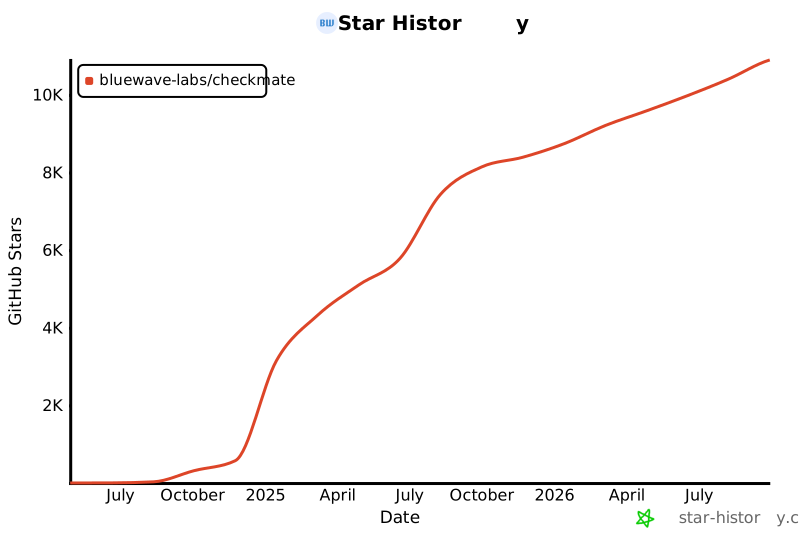](https://star-history.com/#bluewave-labs/bluewave-uptime&Date)
[](https://star-history.com/#bluewave-labs/Checkmate&Date)
## Our sponsors
Thanks to [Gitbook](https://gitbook.io/) for giving us a free tier for their documentation platform, and [Poeditor](https://poeditor.com/) providing us a free account to use their i18n services. If you would like to sponsor Checkmate, please send an email to hello@bluewavelabs.ca
If you would like to sponsor a feature, [see this page](https://checkmate.so/sponsored-features).
Also check other developer and contributor-friendly projects of BlueWave:
- [VerifyWise](https://github.com/bluewave-labs/verifywise), the first open source AI governance platform.
- [DataRoom](https://github.com/bluewave-labs/bluewave-dataroom), an secure file sharing application, aka dataroom.
- [Guidefox](https://github.com/bluewave-labs/guidefox), an application that helps new users learn how to use your product via hints, tours, popups and banners.
'Use the full theme path instead of a string shorthand. e.g. color={theme.palette.text.secondary} not color="text.secondary". See docs/frontend-conventions.md rule #2.',
},
{
// Rule #1 — sx={{ key: ... }} where key has a native prop equivalent.
selector:sxKeySelector,
message:
"Hoist this key out of `sx` onto the component as a native MUI prop (e.g. color={...}, mt={...}, width={...}). See docs/frontend-conventions.md rule #1.",
},
{
// Rule #4 — importing the singleton theme from the Theme module.
// Catches: import { theme } from "@/Utils/Theme/Theme" — should be useTheme() inside the component.
"fontSize={13} is the Typography body default — drop the prop. For other sizes use typographyLevels tokens. See docs/frontend-conventions.md rule #3.",
Loaded 100 of 580 files, more files were not shown because too many files have changed in this diff.
Show more
Reference in new issue
Block a user
Blocking a user prevents them from interacting with repositories, such as opening or commenting on pull requests or issues. Learn more about blocking a user.
 gorkem-bwl
 Alexander Holliday
 harsh-aghara
 Gorkem Cetin
 Aicha Lassoued
 ZeinebMegaadi
 Smolcup
 SkyKing_PX

 egeoztassandClaude Opus 4.6
 mayssagl
 mannilakash
 Adrien Touzouli
 LeC-D
 Aryaman Sharma
 Leandre Chamberland-Dozois
 ashu130698
 Aman Rawat
 tobias.bruckert@mcon-group.com
 karenvicent
 Anton Mrosek
